Advertisements
Advertisements
प्रश्न
Raunak is a small-scale entrepreneur who sells sewing machines in a rural market. He wants to expand his business but has two main constraints: Capital and Storage.
He has a total capital of ₹ 5,760 to invest. The godown can store a maximum number of 20 sewing machines.
Raunak sells two types of machines:
- Electronic sewing machine, each costs him 360.
- Manually operated sewing machine, each costs him 240.
His wife Radhika suggests selling an electronic machine ata profit of ₹ 22 and a manually operated sewing machine at a profit of 18.
Using the concept of Linear Programming Problem, find the number of sewing machines of each type that Raunak should sell to maximise his profit
Advertisements
उत्तर
Let the Variables be:
x = Number of Electronic sewing machines.
y = Number of manually operated sewing machines.
Objective Function:
The goal is to maximise the total profit (Z).
Maximize Z = 22x = 18y
Constraints:
Storage Constraints: x + y ≤ 20
Capital Constraint: 360x + 24y ≤ 5760
3x + 2y ≤ 48 ... [Divide the whole equation by 120 to simplify]
Non-negativity Constraints: x ≥ 0, y ≥ 0
Finding Points for the Graph
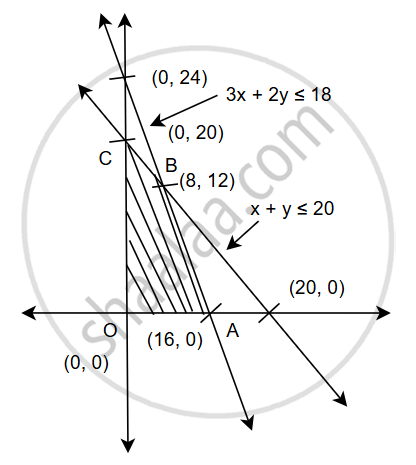
To draw the lines, we find the intercepts (x = 0 and y = 0)
| Equation | If x = 0 | If y = 0 | Points |
| x + y = 20 | y = 20 | x = 20 | (0, 20) and (20, 0) |
| 3x + 2y = 48 | y = 24 | x = 16 | (0, 24) and (16, 0) |
Intersection Point of the lines:
Solving x + y = 20 and 3x + 2y = 48 simulantanneosly:
3x + 2(20 − x) = 48
3x + 40 − 2x = 48
x = 8, y = 12
Profit Calculation at Corner Points
The feasible region is bounded by the points: O(0, 0), A(16, 0), B(8, 12), and C(0, 20).
| Corner Point (x, y) | Objective Function Z = 22x + 18y | Profit (₹) |
| O(0, 0) | 22(0) + 18(0) | 0 |
| A(16, 0) | 22(16) + 18(0) | 352 |
| B(8, 12) | 22(8) + 18(12) | 392(MAX) |
| C(0, 20) | 22(0) + 18(20) | 360 |