Advertisements
Advertisements
प्रश्न
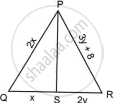
PS bisects ∠QPR and PS ⊥ QR. If PQ = 2x units, PR = (3y + 8) units, QS = x units and SR = 2y units. Find the values of x and y.
Advertisements
उत्तर
Given:
PS bisects ∠QPR and PS ⊥ QR, so PS is both the angle bisector and perpendicular to QR.
PQ = 2x units
PR = 3y + 8 units
QS = x units
SR = 2y units
Step 1: Use the Angle Bisector Theorem
The Angle Bisector Theorem states that if a bisector of an angle in a triangle divides the opposite side, the ratio of the two segments on the opposite side is equal to the ratio of the other two sides of the triangle.
Here, we have:
`(QS)/(SR) = (PQ)/(PR)`
Substitute the given lengths:
`x/(2y) = (2x)/(3y + 8)`
Step 2: Solve the Equation
Cross-multiply to solve for x and y:
x(3y + 8) = 2y(2x)
Expanding both sides:
x(3y + 8) = 4xy
3xy + 8x = 4xy
Now, subtract 3xy from both sides:
8x = xy
If x ≠ 0, divide both sides by x:
8 = y
Thus, y = 8.
Step 3: Substitute y = 8 into the equation for x
Now that we know y = 8, substitute this value into the equation for QS and SR in terms of x:
QS = x, SR = 2y = 16
Use the Angle Bisector Theorem again:
`(QS)/(SR) = (PQ)/(PR)`
Substitute the values:
`x/16 = (2x)/(3(8) + 8)`
Simplify the denominator:
`x/16 = (2x)/(24 + 8) = (2x)/32`
Now, cross-multiply:
x × 32 = 2x × 16
32x = 32x
This is true for all values of x, but we know that from the previous step, the value of x must be 16 to satisfy the ratio condition.
The values of x and y are x = 16, y = 8.
Thus, we have x = 16, y = 8.
