Advertisements
Advertisements
प्रश्न
Prove that the equation to the straight lines through the origin, each of which makes an angle α with the straight line y = x is x2 – 2xy sec 2α + y2 = 0
Advertisements
उत्तर
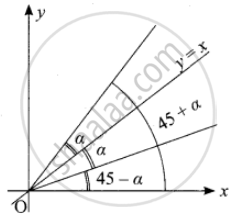
Slope of y = x is m = tan θ = 1
⇒ θ = 45°
The new lines slopes will be
m = tan(45 + α) and m = tan (45 – α)
∴ The equations of the lines passing through the origin is given by
y = tan(45 + α)x and y = tan(45 – α)x
(i.e) y = tan(45 + α)x = 0 and y = tan(45 – α)x = 0
The combined equation is [y – tan (45 + α)x][y – tan (45 – α)x] = 0
y2 + tan(45 + α)tan(45 – α)x2 – xy[tan(45 – α) + tan(45 + α)] = 0
(i.e) `y^2 + (1 + tan alpha)/(1 - tan alpha) xx (1 - tan alpha)/(1 + tan alpha) x^2 - xy [(sin(45 - alpha))/(cos(45 - alpha)) + (sin(5 + alpha))/(cos(45 + alpha))]` = 0
(i.e) `x^2 + y^2 - xy ([sin(45 - alpha) cos(45 + alpha) + cos(45 - alpha) sin(45 + alpha)])/(cos(45 - alpha) cos(45 + alpha)`
(i.e) `x^2 + y^2 - xy ([sin (45 + 45)])/(1/2[2cos(45 - alpha) cos(45 + alpha)])` = 0
`x^2 + y^2 - (2xy)/(cos 90 + cos 2alpha)` = 0
⇒ `x^2- (2xy)/(cos 2alpha) + y^2` =0
(i.e x2 – 2xy sec 2α +y2 = 0
Aliter:
Let the slopes of the lines be m1 and m2 where
m1 = tan(45 – α)
= `(1 - tan alpha)/(1 + tan alpha)`
and
m2 = tan(45 + α)
= `(1 + tan alpha)/(1 - tan alpha)`
m1 + m2 = `(1 - tan alpha)/(1 + tan alpha) + (1 + tan alpha)/(1 - tan alpha)`
= `2(1/(cos2alpha))`
= 2sec 2α
m1m2 = `(1 - tan alpha)/(1 + tan alpha) xx (1 - tan alpha)/(1 - tan alpha)` = 1
Let the equation of lines passes through the origin
So the equations are y = m1x = 0 and y = m2x = 0
So the combined equations is (y – m1x)(y – m2x) = 0
(i.e)y2 – xy(m1 + m2) + m1m2x = 0
(i.e) y2 – xy(2sec α) + x2(1) = 0
(i.e) y2 – 2xy sec 2α + x2 = 0
APPEARS IN
संबंधित प्रश्न
If the equation ax2 + 5xy – 6y2 + 12x + 5y + c = 0 represents a pair of perpendicular straight lines, find a and c.
Find the angle between the pair of straight lines 3x2 – 5xy – 2y2 + 17x + y + 10 = 0.
If m1 and m2 are the slopes of the pair of lines given by ax2 + 2hxy + by2 = 0, then the value of m1 + m2 is:
The angle between the pair of straight lines x2 – 7xy + 4y2 = 0 is:
If the lines 2x – 3y – 5 = 0 and 3x – 4y – 7 = 0 are the diameters of a circle, then its centre is:
Show that the equation 2x2 − xy − 3y2 − 6x + 19y − 20 = 0 represents a pair of intersecting lines. Show further that the angle between them is tan−1(5)
Find the equation of the pair of straight lines passing through the point (1, 3) and perpendicular to the lines 2x − 3y + 1 = 0 and 5x + y − 3 = 0
Find the separate equation of the following pair of straight lines
2x2 – xy – 3y2 – 6x + 19y – 20 = 0
The slope of one of the straight lines ax2 + 2hxy + by2 = 0 is twice that of the other, show that 8h2 = 9ab
A ∆OPQ is formed by the pair of straight lines x2 – 4xy + y2 = 0 and the line PQ. The equation of PQ is x + y – 2 = 0, Find the equation of the median of the triangle ∆ OPQ drawn from the origin O
Find the value of k, if the following equation represents a pair of straight lines. Further, find whether these lines are parallel or intersecting, 12x2 + 7xy − 12y2 − x + 7y + k = 0
For what values of k does the equation 12x2 + 2kxy + 2y2 +11x – 5y + 2 = 0 represent two straight lines
Choose the correct alternative:
Equation of the straight line that forms an isosceles triangle with coordinate axes in the I-quadrant with perimeter `4 + 2sqrt(2)` is
Choose the correct alternative:
The coordinates of the four vertices of a quadrilateral are (−2, 4), (−1, 2), (1, 2) and (2, 4) taken in order. The equation of the line passing through the vertex (−1, 2) and dividing the quadrilateral in the equal areas is
Choose the correct alternative:
If the equation of the base opposite to the vertex (2, 3) of an equilateral triangle is x + y = 2, then the length of a side is
Choose the correct alternative:
The image of the point (2, 3) in the line y = −x is
Choose the correct alternative:
The length of ⊥ from the origin to the line `x/3 - y/4` = 1 is
Let the equation of the pair of lines, y = px and y = qx, can be written as (y – px) (y – qx) = 0. Then the equation of the pair of the angle bisectors of the lines x2 – 4xy – 5y2 = 0 is ______.
