Advertisements
Advertisements
प्रश्न
Prove that the area of right-angled triangle of given hypotenuse is maximum when the triangle is isosceles.
Advertisements
उत्तर
Let h be the hypotenuse of the right-angled triangle and x be its altitude.
So, base = `sqrt(h^2 - x^2)` ...[Using pythagoras theroem]
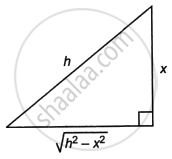
Now, area of triangle (A) = `1/2 xx sqrt(h^2 - x^2) xx x`
∴ `(dA)/dx = 1/2 [x{1/2 (h^2 - x^2)^(-1//2) xx (-2x)} + sqrt(h^2 - x^2)]`
= `1/2 [(-x^2)/sqrt(h^2 - x^2) + sqrt(h^2 - x^2)]`
= `1/2 [(-x^2 + h^2 - x^2)/sqrt(h^2 - x^2)]`
= `1/2 [(h^2 - 2x^2)/sqrt(h^2 - x^2)]`
And `(d^2A)/(dx^2) = 1/2 [(sqrt(h^2 - x^2). (-4x) - (h^2 - 2x^2) {1/2 (h^2 - x^2)^(-1//2) (-2x)})/((sqrt(h^2 - x^2))^2)]`
= `1/2 [(-4x (sqrt(h^2 - x^2)) + ((h^2 - 2x^2)x)/sqrt(h^2 - x^2))/((h^2 - x^2))]`
= `1/2 [(-4x (h^2 - x^2) + (h^2 - 2x^2)x)/((h^2 - x^2).sqrt(h^2 - x^2))]`
= `1/2 [(-4xh^2 + 4x^3 + h^2x - 2x^3)/((h^2 - x^2)^(3//2))]`
= `1/2 [(2x^3 - 3xh^2)/(h^2 - x^2)^(3//2)]`
For maximum and minimum value,
Put `(dA)/dx = 0`
⇒ `1/2 [(h^2 - 2x^2)/(sqrt(h^2 - x^2))] = 0`
⇒ h2 – 2x2 = 0
⇒ `x = h/sqrt(2)`
∴ `((d^2A)/(dx^2))_(x = h/sqrt(2)) = 1/2 [(2 xx h^3/(2sqrt(2)) - 3 xx h/sqrt(2) xx h^2)/((h^2 - h^2/2)^(3//2))]`
= `1/2 [(h^3 - 3h^3)/((h^2/2)^(3//2) sqrt(2))]`
= `(-2h^3)/(2 xx h^3/(2sqrt(2)) xx sqrt(2))`
= –2 < 0
Thus, A is maximum at `x = h/sqrt(2)`
Now, Base = `sqrt(h^2 - x^2)`
= `sqrt(h^2 - h^2/2)`
= `sqrt(h^2/2)`
= `h/sqrt(2)`
And Altitude = x = `h/sqrt(2)`
Base = `sqrt(h^2 - x^2)`
= `sqrt(h^2 - (h/sqrt(2))^2`
= `h/sqrt(2)`
Since, Base = Altitude = `h/sqrt(2)`
Hence, the triangle is isosceles.
Hence Proved.
