Advertisements
Advertisements
प्रश्न
Prove that “in a right triangle, the square of the hypotenuse is equal to the sum of the squares of the other two sides.”
Advertisements
उत्तर १
To prove: In a right-angled triangle, the square of the hypotenuse is equal to the sum of squares of the other two sides of the triangle.
Proof: Let PQR be a triangle, right-angled at P.
Draw PS ⊥ QR
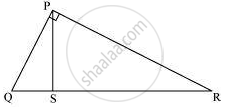
Now, we know that if a perpendicular is drawn from the vertex of the right angle of a right triangle to the hypotenuse, then the triangles on both sides of the perpendicular are similar to the whole triangle and to each other.
∴ΔQSP ∼ ΔQPR
Therefore, `"QS"/"QP" = "QP"/"QR"` .....................(Since the sides of similar triangles are proportional)
⇒ QS. QR = Qp2 .......(1)
Also, we have
ΔPSR ∼ ΔQPR
Therefore, `"RS"/"RP" = "RP"/"RQ"`.............(Since the sides of similar triangles are proportional)
⇒ RS.RQ = RP2 … (2)
Adding equations (1) and (2), we obtain
QS.QR + RS.RQ = RP2 + QP2
⇒ QR. (QS + RS) = RP2 + QP2
⇒ QR.QR = RP2 + QP2
⇒ QR2 = RP2 + QP2
Thus, the square of the hypotenuse is equal to the sum of squares of the other two sides of the triangle.
उत्तर २
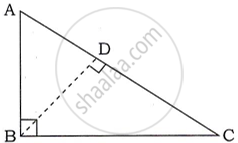
Given: In ΔABC, m∠B = 90°
To prove: AC2 = AB2 + BC2
Construction: Draw seg BO ⊥ hypotenuse AC
Proof:
ΔABC ~ ΔADB ...[similarity in right angled traingles]
∴ `"AB"/"AD" = "AC"/"AB"` ...[c.s.s.t.]
∴ AB2 = AC × AD ...(I)
ΔABC ~ ΔBDC ...[similarity in right angled triangles]
∴ `"BC"/"DC" = "AC"/"BC"` ...[c.s.s.t.]
∴ BC2 = AC × DC ...(II)
Adding (I) and (II) we get,
AB2 + BC2 = AC × AD + AC × DC
= AC(AD + DC)
= AC × AC ...[A-D-C]
∴ AB2 + BC2 = AC2
