Advertisements
Advertisements
प्रश्न
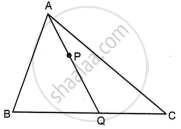
P is any point inside the triangle ABC. AP is produced to meet BC in Q.
Prove that
- ∠BPQ > ∠BAQ
- ∠BPC > ∠BAC
Advertisements
उत्तर
Given:
P is any point inside the triangle ABC.
AP is produced to meet BC at Q.
To Prove:
- ∠BPQ > ∠BAQ
- ∠BPC > ∠BAC
Proof:
Step 1: Consider the triangle APQ.
Since Q lies on BC extended, Q lies outside the triangle ABC and AP is extended to Q.
Step 2: To prove (i) ∠BPQ > ∠BAQ
In triangle APQ, consider points B and A on the same side.
Since P is inside ABC and Q lies on BC extended, point B lies on segment BQ.
Observe triangle BPQ and triangle BAQ.
Since Q lies on BC extended beyond C or B depending on configuration, the angle ∠BPQ lies outside the smaller triangle BAQ, making ∠BPQ larger than ∠BAQ.
Intuitively, exterior angle ∠BPQ > interior opposite angle ∠BAQ.
Therefore, ∠BPQ > ∠BAQ.
Step 3: To prove (ii) ∠BPC > ∠BAC
In triangle BPC, we compare ∠BPC with ∠BAC of triangle ABC.
Since P lies inside ABC, extending AP to Q helps relate angles at P.
By angle exterior property: The exterior angle of a triangle is greater than either of the interior opposite angles.
Extending BP or PC and comparing with ∠BAC shows that ∠BPC is an exterior angle to some triangle involving A, thereby ∠BPC > ∠BAC.
Alternatively,
Extend BP to point R on AC.
By the exterior angle theorem, ∠BPC > ∠PQC
And ∠PQC > ∠BAC because P lies inside ABC.
Therefore, ∠BPC > ∠BAC.
