Advertisements
Advertisements
प्रश्न
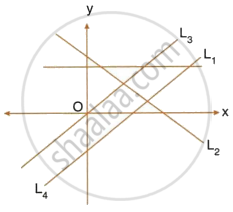
Match the equations A, B, C and D with the lines L1, L2, L3 and L4, whose graphs are roughly drawn in the given diagram.
A ≡ y = 2x;
B ≡ y – 2x + 2 = 0;
C ≡ 3x + 2y = 6;
D ≡ y = 2
Advertisements
उत्तर
Putting x = 0 and y = 0 in the equation y = 2x, we have:
LHS = 0 and RHS = 0
Thus, the line y = 2x passes through the origin.
Hence, A = L3
Putting x = 0 in y − 2x + 2 = 0, we get, y = −2
Putting y = 0 in y − 2x + 2 = 0, we get, x = 1
So, x-intercept = 1 and y-intercept = −2
So, x-intercept is positive and y-intercept is negative.
Hence, B = L4
Putting x = 0 in 3x + 2y = 6, we get, y = 3
Putting y = 0 in 3x + 2y = 6, we get, x = 2
So, both x-intercept and y-intercept are positive.
Hence, C = L2
The slope of the line y = 2 is 0.
So, the line y = 2 is parallel to x-axis.
Hence, D = L1
