Advertisements
Advertisements
प्रश्न
Market for a good is in equilibrium. There is simultaneous “decrease” both in demand and supply but there is no change in market price. Explain with the help of a schedule how it is possible.
Advertisements
उत्तर
With a simultaneous decrease in both the demand and supply, it is possible that the equilibrium market price would not change under a situation where both demand and supply decrease in the same proportion. In such a case, only the equilibrium quantity falls, whereas, the equilibrium price remains unchanged.
The following schedule explains this.
|
Price (Rs) |
Initial Demand (D1) |
Initial Supply (S1 ) |
Final Demand (D2) |
Final Supply (S2) |
|
2 |
30 |
10 |
26 |
6 |
|
4 |
25 |
15 |
21 |
11 |
|
6 |
20 |
20 |
16 |
16 |
|
8 |
15 |
25 |
11 |
21 |
|
10 |
10 |
30 |
6 |
26 |
In the above schedule, initial equilibrium price is Rs 6 where both demand and supply are equal to 20 units. Now suppose both demand and supply decrease in the same proportion that is, by 4 units. Again, the equilibrium price is established at Rs 6 where both demand and supply equal at 16 units.
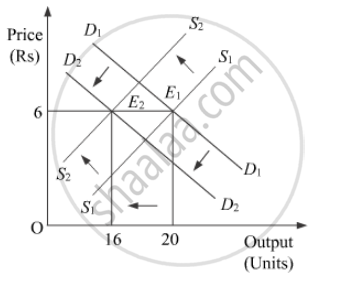
In the above figure, S1S1 and D1D1 are the initial supply and demand curve respectively. Initial equilibrium is established at point E1.Accordingly, Rs 6 is the equilibrium price and 20 units is the equilibrium quantity.
With a decrease in demand, the demand curve shifts parallely leftwards to D2D2. Simultaneously, with a equal fall in supply, the supply curve shifts parallely upwards to the left of S2S2. The new equilibrium is established at E2. At the new equilibrium price has remained the same at Rs 6, but the equilibrium quantity has fallen from 20 units to 16 units.
