Advertisements
Advertisements
प्रश्न
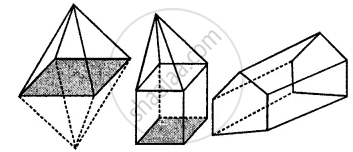
Look at the shapes given below and state which of these are polyhedra using Euler’s formula.

Advertisements
उत्तर
In the given figure, we have
Faces (F) = 11, Vertices (V) = 11 and Edges (E) = 20
On putting these values in Euler’s formula, we get
F + V – E = 2
⇒ 11 + 11 – 20 = 2
⇒ 22 – 20 = 2
⇒ 2 = 2
Hence, these values satisfies the Euler’s formula. So, it is a polyhedra.
APPEARS IN
संबंधित प्रश्न
Verify Euler’s formula for the following three-dimensional figures:
Using Euler's formula, find the values of x, y, z.
| Faces | Vertices | Edges | |
| (i) | x | 15 | 20 |
| (ii) | 6 | y | 8 |
| (iii) | 14 | 26 | z |
Complete the table given below:
| S.No | Solid | Shape of Solid |
Number of faces F |
Number of Verticles V |
Number of edges E |
F + V | E + 2 |
| a. | Cuboid |  |
|||||
| b. | Triangular Pyramid |
 |
|||||
| c. | Square Pyramid |
 |
|||||
| d. | Rectangular Pyramid |
 |
|||||
| e. | Pentagonal Pyramid |
 |
|||||
| f. | Hexagonal Pyramid |
 |
|||||
| g. | Triangular Prism |
 |
|||||
| h. | Square Prism |
 |
|||||
| i. | Cube |  |
|||||
| j. | Pentagonal Prism |
 |
|||||
| k. | Octagonal Prism |
 |
|||||
| l. | Heptagonal Prism |
 |
Look at the shapes given below and state which of these are polyhedra using Euler’s formula.

Look at the shapes given below and state which of these are polyhedra using Euler’s formula.

Look at the shapes given below and state which of these are polyhedra using Euler’s formula.

Look at the shapes given below and state which of these are polyhedra using Euler’s formula.

Using Euler’s formula, find the value of unknown y in the following table.
| Faces | y |
| Vertices | 12 |
| Edges | 18 |
A polyhedron has 20 faces and 12 vertices. Find the edges of the polyhedron.
A solid has forty faces and sixty edges. Find the number of vertices of the solid.
