Advertisements
Advertisements
प्रश्न
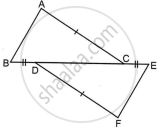
In the given triangles, AC = DF, BD = CE and ∠ACB = ∠FDE. Prove that ∠A = ∠F.
प्रमेय
Advertisements
उत्तर
Step 1: Analyze the given information
We are given:
- ΔABC and ΔDEF
- AC = DF ...(Side)
- BD = CE ...(Segments inside the triangles)
- ∠ACB = ∠FDE ...(Angles at C and E)
We are asked to prove equality of angles at A and F.
This hints at triangle congruence using SAS or other criteria, but we need to carefully consider which triangles to compare.
Step 2: Consider triangles containing the given angle
- Consider triangles formed by the given angle and sides around it.
- In ΔABC, consider triangle ACB and in ΔDEF, consider triangle DFE:
- We know: AC = DF
- ∠ACB = ∠FDE
- Also, segments opposite the angle: BD = CE
This suggests we can try SAS congruence two sides and the included angle.
Step 3: Apply SAS criterion
- ΔABC and ΔDEF:
- Side 1: AC = DF ...(Given)
- Angle included: ∠ACB = ∠FDE ...(Given)
- Side 2 opposite angle: BC = DE?
- We are given BD = CE, which might relate to the sides from B to D and C to E.
- If we assume BD and CE are perpendiculars or heights, we can use angle-side relationships or consider ASA criterion: two angles and included side.
Step 4: Consider ASA congruence (angle-side-angle)
- Known: ∠ACB = ∠FDE
- Side opposite: AC = DF
- Then, if we can show that ∠ABC = ∠DEF or use the other given segment BD = CE to relate, we can conclude ΔABC ≅ ΔDEF ...(By ASA)
- Once triangles are congruent, corresponding angles are equal ∠A = ∠F
Step 5: Conclude
∠A = ∠F
The proof relies on triangle congruence ASA or SAS using:
- One pair of sides: AC = DF
- Included angle: ∠ACB = ∠FDE
- Another pair of sides: BD = CE
This ensures ΔABC ≅ ΔDEF, so ∠A = ∠F.
shaalaa.com
क्या इस प्रश्न या उत्तर में कोई त्रुटि है?
