Advertisements
Advertisements
प्रश्न
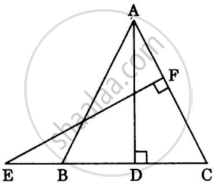
In the given figure, E is the point on side CB produced of an isosceles ΔABC with AB = AC. If AD ⊥ BC and EF ⊥ AC, prove that ΔABD ∼ ΔECF. Hence, prove that `(AC)/(EC) = (BD)/(CF)`.
Advertisements
उत्तर
ΔABC is an isosceles triangle where AB = AC.
AD ⊥ BC (∠ADB = 90°)
EF ⊥ AC (∠EFC = 90°)
To Prove:
ΔABD ∼ ΔECF
`(AC)/(EC) = (BD)/(CF)`
Proof:
Part 1: Proving similarity (ΔABD ∼ ΔECF)
In ΔABC, it is given that AB = AC.
Therefore, ∠ABD = ∠ACD. ...(Angles opposite to equal sides of a triangle are equal)
We can also write this as ∠ABD = ∠ECF since D, C and B lie on the same line. – (Equation 1)
Now, let’s compare ΔABD and ΔECF:
∠ADB = ∠EFC = 90° ...(Given that AD ⊥ BC and EF ⊥ AC)
∠ABD = ∠ECF ...(From equation 1)
By the AA (Angle-Angle) Similarity Criterion, we have:
ΔABD ∼ ΔECF
Part 2: Proving the ratio `((AC)/(EC) = (BD)/(CF))`
Since the triangles are similar (ΔABD ∼ ΔECF), their corresponding sides must be proportional:
`(AB)/(EC) = (BD)/(CF) = (AD)/(EF)`
From the first two parts of the ratio, we get:
`(AB)/(EC) = (BD)/(CF)`
Since it is given that AB = AC, we can substitute AC for AB in the equation:
`(AC)/(EC) = (BD)/(CF)`
Hence Proved.
