Advertisements
Advertisements
प्रश्न
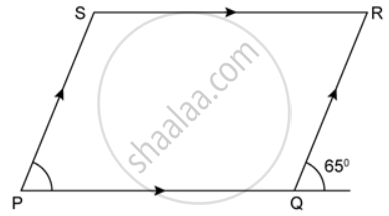
In the following figures, find the remaining angles of the parallelogram
Advertisements
उत्तर
∠PQR + 65° = 180° ....(Linear pair angles)
⇒ ∠PQR = 115°
PQRS is a parallelogram.
∠S = ∠Q = ∠115° ....(Opposite angles of a parallelogram are equal)
And, ∠P + ∠S = 180° ....(Interior angles)
⇒ ∠P + 115° = 180°
⇒ ∠P = 65°
⇒ ∠R = ∠P = 65° ....(Opposite angles of a parallelogram are equal)
Thus, we have
∠P = 65°, ∠Q = 115°, ∠R = 65° and ∠S = 115°.
APPEARS IN
संबंधित प्रश्न
In case of a parallelogram
prove that:
(i) The bisectors of any two adjacent angles intersect at 90o.
(ii) The bisectors of the opposite angles are parallel to each other.
In the following figure, ABCD is a parallelogram. 
Prove that:
(i) AP bisects angle A.
(ii) BP bisects angle B
(iii) ∠DAP + ∠BCP = ∠APB
In the following figures, find the remaining angles of the parallelogram
The consecutive angles of a parallelogram are in the ratio 3:6. Calculate the measures of all the angles of the parallelogram.
PQR is a triangle formed by the adjacent sides PQ and QR and diagonal PR of a parallelogram PQRS. If in ΔPQR, ∠P : ∠Q : ∠R = 3 : 8 : 4, Calculate the measures of all the angles of parallelogram PQRS.

Opposite angles of a quadrilateral ABCD are equal. If AB = 4 cm, determine CD.
If PQRS is a parallelogram, then ∠P – ∠R is equal to ______.
