Advertisements
Advertisements
प्रश्न
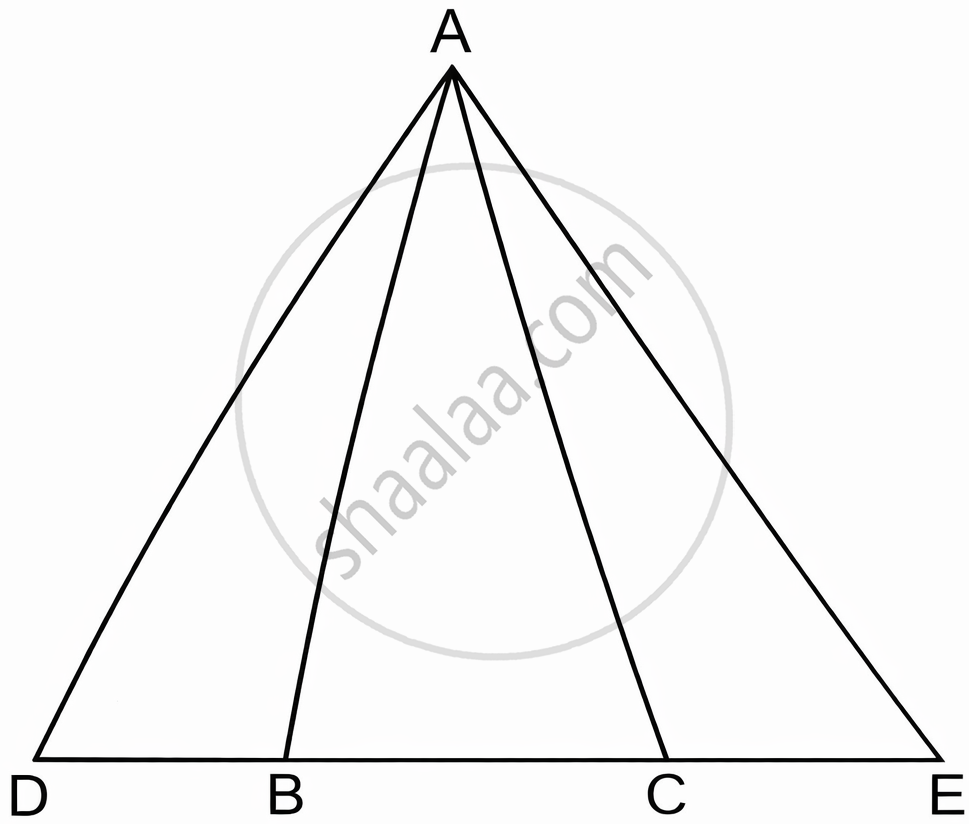
In the following figure, AB = AC and AB2 = BD × CE. Prove that ΔADB ~ ΔЕАС.
योग
Advertisements
उत्तर
Given:
AB = AC and AB2 = BD × CE, with D, B, C, E collinear.
Since AB = AC, in △ABC, base angles opposite equal sides are equal.
∴ ∠ABC = ∠BCA
Now D, B, C, and E are collinear, so BD is the extension of BC, and CE is the extension of CB.
Hence,
∠ABD = 180° − ∠ABC and ∠ACE = 180° − ∠BCA
But ∠ABC = ∠BCA. Therefore,
∠ABD = ∠ACE
Also, given
AB2 = BD × CE
So,
AB × AB = BD × CE
Since AB = AC, we get
AB × AC = BD × CE
Dividing both sides by AC × CE, we obtain
`(BD)/(AC) = (AB)/(CE)`
Thus, in △ADB and △EAC,
`(BD)/(AC) = (AB)/(CE)` and ∠ABD = ∠ACE
Therefore, by SAS similarity,
△ADB ∼ △EAC
Hence proved.
shaalaa.com
क्या इस प्रश्न या उत्तर में कोई त्रुटि है?
अध्याय 13: Similarity - Exercise 13A [पृष्ठ २७८]
