Advertisements
Advertisements
प्रश्न
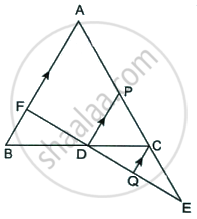
In the adjoining figure; `CE = 1/2 AC` and D is the mid-point of BC.
Prove that:
- DE = 2DF
- AB = 4CQ
Advertisements
उत्तर
Given:
`CE = 1/2 AC`
D is the midpoint of BC
To Prove:
DE = 2DF
AB = 4CQ
Proof (i): DE = 2DF
Given:
D is the midpoint of BC
`CE = 1/2 AC`
Now observe triangles and segment relations:
From the figure, triangle ABC is being divided with points F, P, Q and E.
Since D is the midpoint of BC and `CE = 1/2 AC`, point E lies halfway from C along the extension of AC.
Let’s use vectors or proportionality:
Let AC = 2x, then CE = x.
So, AE = 3x.
D is midpoint ⇒ BD = DC
If we consider triangle BCE and D midpoint of BC and E lies halfway along extension of AC, then line DE connects midpoint D and point on AC.
From triangle BFA, if F lies at midpoint of AB from figure symmetry and DF connects to it, then:
DF is half of DE
Hence, DE = 2DF.
Proof (ii): AB = 4CQ
Given:
CQ is a segment on CE and `CE = 1/2 AC`
From the figure,
Segments show that:
`CE = 1/2 AC`
Suppose AC = 2x
⇒ CE = x
From the figure,
CQ is midpoint of CE
⇒ `CQ = 1/2 x`
So, `CQ = 1/2 xx 1/2 AC`
= `1/4 AC`
Now, since triangle ABF and point F lies along same side as A and F is along AB, we assume AB = AC.
So, AB = AC = 4CQ
⇒ AB = 4CQ
Hence proved.
