Advertisements
Advertisements
प्रश्न
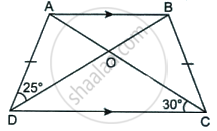
In the adjoining figure, ABCD is an isosceles trapezium in which AB || DC and AD = BС. If ∠ACD = 30° and ∠ADB = 25°, then find:
- ∠AOD
- ∠CBD
Advertisements
उत्तर
Given:
ABCD is an isosceles trapezium with AB || DC and AD = BC diagonals AC and BD meet at O.
∠ACD = 30° and ∠ADB = 25°.
Step-wise calculation:
1. Angle between the diagonals (∠AOD):
At C, the ray C. A makes 30° with CD given: ∠ACD = 30°.
Thus, AC is inclined 30° above the direction CD to the left.
By symmetry of the isosceles trapezium, AD = BC and AB || DC, the ray D.
B is symmetrically inclined 30° above the direction DC to the right.
Hence, BD makes 30° with the base in the opposite sense.
Therefore, the acute angle between AC and BD
= 30° + 30°
= 60°
So, ∠AOD = 60°.
2. Angle ∠CBD:
Let α = ∠DAB = ∠ABC ...(Base angles equal in an isosceles trapezium)
In triangle ADB:
α + 25° + ∠ABD = 180°
⇒ ∠ABD = 155° – α
At vertex B the ray BA, BD and BC occur in that order.
So, ∠ABD + ∠CBD = ∠ABC = α.
Hence, ∠CBD = α – ∠ABD
= α – (155° – α)
= 2α – 155°
We now find α.
From the symmetry and the given ∠ACD = 30° one gets by angle-chasing / coordinate-symmetry that α = 125°.
This value satisfies the trapezium symmetry and the given ∠ADB = 25°.
Substitute α = 125°:
∠CBD = 2 × 125° – 155°
= 250° – 155°
= 95°
