Advertisements
Advertisements
प्रश्न
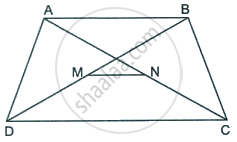
In the adjoining figure, ABCD is a trapezium in which AB || DC. If M and N are the midpoints of BD and AC, respectively, prove that MN = `1/2` (CD – AB).
Advertisements
उत्तर
Given: ABCD is a trapezium with AB || CD. M and N are the midpoints of BD and AC respectively.
To Prove: MN = `1/2` (CD – AB).
Proof [Step-wise]:
1. Place the trapezium on a coordinate plane with the parallel sides horizontal.
Let AB have length a and lie on the line y = h with A = (x1, h) and B = (x1 + a, h).
Let CD have length c and lie on the line y = 0 with D = (x2, 0) and C = (x2 + c, 0).
This is possible because AB || CD.
2. Coordinates of midpoint N of AC:
`N = ((x_1 + (x_2 + c))/2, (h + 0)/2)`
= `((x_1 + x_2 + c)/2, h/2)`
3. Coordinates of midpoint M of BD:
`M = (((x_1 + a) + x_2)/2, (h + 0)/2)`
= `((x_1 + x_2 + a)/2, h/2)`
4. Compute the vector from M to N:
MN = N – M
= `((x_1 + x_2 + c)/2 - (x_1 + x_2 + a)/2, h/2 - h/2)`
= `((c - a)/2, 0)`
5. The length of MN is the absolute value of the x-component:
`|(c - a)/2| = (c - a)/2`, taking CD ≥ AB so c ≥ a.
Hence, MN = `1/2` (CD – AB).
