Advertisements
Advertisements
प्रश्न
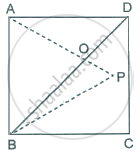
In the adjoining figure, ◻ABCD is a square and ΔABP is an equilateral triangle.
Find :
- ∠AOB
- ∠CPB
- ∠PCD
Advertisements
उत्तर
Given:
ABCD is a square.
ΔABP is equilateral.
O is the intersection of the diagonals center of the square.
Place coordinates:
A(0, 1)
B(0, 0)
C(1, 0)
D(1, 1)
And Side = 1
Then `P = (sqrt(3)/2, 1/2)`
Step-wise calculation:
1. ∠AOB (Vertex at O):
`O = (1/2, 1/2)`
OA = A – O
= `(-1/2, 1/2)`
OB = B – O
= `(-1/2, -1/2)`
Dot product OA·OB
= `(-1/2)(-1/2) + (1/2)(-1/2)`
= 0
Zero dot product
⇒ OA ⟂ OB
⇒ ∠AOB = 90°
2. ∠CPB (Vertex at P):
`P = (h, 1/2)` with `h = sqrt(3)/2 ≈ 0.8660`.
PB = B – P
= `(-h, -1/2)`
PC = C − P
= `(1 - h, -1/2)`
`PB·PC = (-h)(1 - h) + (-1/2)(-1/2)`
= `-h(1 - h) + 1/4`
With `h = sqrt(3)/2`.
Evaluate: PB·PC = 0.133975...
|PB| = 1 ...`("Since" PB^2 = h^2 + (1/2)^2 = 3/4 + 1/4 = 1)`
`|PC| = sqrt( (1 - h)^2 + (1/2)^2) ≈ 0.5177`
`cos ∠CPB = (PB·PC)/(|PB||PC|)`
= `0.133975/0.5177`
= 0.258819
⇒ ∠CPB = arccos(0.258819)
⇒ ∠CPB = 75°
3. ∠PCD (Vertex at C):
CD vector = D – C
= (0, 1)
CP = P – C
= `(h - 1, 1/2)`
= `(-0.133975, 1/2)`
Dot CD·CP
= `0 xx (h - 1) + 1 xx (1/2)`
= `1/2`
|CP| ≈ 0.5177
|CD| = 1
⇒ cos ∠PCD = `(1/2)/0.5177 ≈ 0.9659258`
⇒ ∠PCD ≈ 15°
These 75° and 15° values match standard worked examples for a square with an equilateral triangle on one side.
- ∠AOB = 90°
- ∠CPB = 75°
- ∠PCD = 15°
