Advertisements
Advertisements
प्रश्न
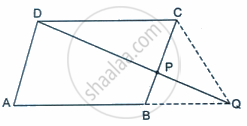
In the adjoining figure, ABCD is a parallelogram. P is a point on BC such that BP : PC = 1 : 2 and DP produced meets AB produced at Q.
If area of ΔCPQ = 20 cm2, find:
- area of ΔBPQ.
- area of ΔCDP.
Advertisements
उत्तर
Given:
ABCD is a parallelogram. P is a point on BC such that, BP : PC = 1 : 2 and DP produced meets AB produced at Q.
Also,
ar(△CQP) = 20 cm2
Since BP : PC = 1 : 2, point P divides BC in the ratio 1 : 2.
Hence, the perpendicular distance of P from AB is `1/3` of the distance between the parallel lines AB and DC.
Let, AB = DC = b and height of parallelogram = h
So, ar(ABCD) = bh
Now, △CQP has a base on the same line as AB, and from the figure, its area is `1/6` of the area of the parallelogram ABCD. Therefore,
ar(△CQP) = `1/6 bh`
But given, ar(△CQP) = 20
So, `1/6 bh = 20`
bh = 120
Hence, ar(ABCD) = 120 cm2
(i) Area of △BPQ:
In △BPQ,
- base BQ = `1/2 AB` = `b/2`
- height of P above AB = `h/3`
Therefore,
ar(△BPQ) = `1/2 xx b/2 xx h/3 = (bh)/12`
Substituting bh = 120,
ar(△BPQ) = `120/12`
∴ ar(△BPQ) = 10 cm2
(ii) Area of △CDP:
In △CDP,
- base CD = b
- perpendicular distance of P from CD = `(2h)/3`
Therefore,
ar(△CDP) = `1/2 xx b xx (2h)/3 = (bh)/3`
Substituting bh = 120,
ar(△CDP) = `120/3`
∴ ar(△CDP) = 40 cm2
