Advertisements
Advertisements
प्रश्न
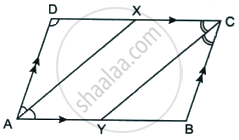
In the adjoining figure, ABCD is a parallelogram. AX and CY are the bisectors of ∠A and ∠C respectively.
Prove that :
- ΔADX ≅ ΔCBY
- AX || CY
- AYCX is a parallelogram.
Advertisements
उत्तर
Given:
ABCD is a parallelogram.
AX is the bisector of ∠A.
CY is the bisector of ∠C.
From ABCD being a parallelogram, we may use:
AD || BC
AB || CD
AD = BC
AB = CD
And ∠A = ∠C, ∠B = ∠D
To Prove:
- △ADX ≅ △CBY
- AX || CY
- AYCX is a parallelogram
Proof [Step-wise]:
1. Parallelogram facts:
AD = BC ...(Opposite sides of a parallelogram)
AB || CD and AD || BC
∠A = ∠C ...(Opposite angles of a parallelogram)
2. Angle relations from bisectors:
AX bisects ∠A
⇒ ∠DAX = ∠XAB
⇒ `∠DAX = 1/2 ∠A`
CY bisects ∠C
⇒ ∠BCY = ∠YCD
⇒ `∠BCY = 1/2 ∠C`
Since ∠A = ∠C, we get
∠DAX = ∠BCY
Thus, one pair of corresponding angles in the two triangles are equal.
3. Angles at D and B:
X lies on DC
So, ∠ADX = ∠ADC angle formed by AD and DX where DX is along DC.
Y lies on AB
So, ∠CBY = ∠CBA angle formed by BC and BY where BY is along BA.
In a parallelogram ∠ADC = ∠CBA since ∠D = ∠B.
Hence, ∠ADX = ∠CBY.
4. Establish congruence (ASA):
In △ADX and △CBY:
- AD = BC ...(Step 1)
- ∠ADX = ∠CBY ...(Step 3)
- ∠DAX = ∠BCY ...(Step 2)
Therefore, by ASA, △ADX ≅ △CBY.
This proves (i).
5. From congruence / angle-equality to parallelism:
From step 2, we had ∠DAX = ∠BCY.
But AD || BC (Step 1).
So, if the angle that AX makes with AD equals the angle that CY makes with BC, the lines AX and CY are parallel, corresponding/alternate interior angle reasoning.
Hence, AX || CY.
This proves (ii).
6. Prove AYCX is a parallelogram:
We already have AX || CY (Step 5).
AY is a part of AB and CX is a part of CD.
Since AB || CD (Step 1), AY || CX.
Both pairs of opposite sides of quadrilateral AYCX are parallel.
So, AYCX is a parallelogram.
This proves (iii).
