Advertisements
Advertisements
प्रश्न
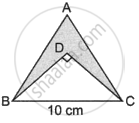
In the adjoining figure, ABC is an equilateral triangle in which BC = 10 cm and BCD is a right-angled triangle in which BD = CD. Find the area of the shaded region.
Advertisements
उत्तर
Given:
ABC is equilateral with BC = 10 cm.
Triangle BCD is right-angled at D with BD = CD so BDC is an isosceles right triangle.
Step-wise calculation:
1. In an isosceles right triangle the hypotenuse = `"leg"·sqrt(2)`.
Here, BC is the hypotenuse.
So, each leg BD = CD
= `"BC"/sqrt(2)`
= `10/sqrt(2)`
= `5sqrt(2)` cm
2. Area of ΔBCD (right triangle with legs BD and CD):
Area BCD = `1/2` × BD × CD
= `1/2 xx (5sqrt(2)) xx (5sqrt(2))`
= `1/2 xx 50`
= 25 cm2
3. Area of equilateral ΔABC with side a = 10 is
Area ABC = `sqrt(3)/4 xx a^2`
= `sqrt(3)/4 xx 100`
= `25sqrt(3)` cm2
4. Shaded area = Area ABC − Area BCD
= `25sqrt(3) - 25`
= `25(sqrt(3) - 1)` cm2
Shaded area = `25(sqrt(3) - 1)` cm2
= 25(1.732 – 1)
= 18.3 cm2
