Advertisements
Advertisements
प्रश्न
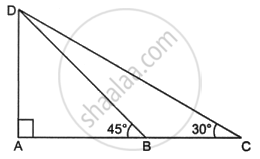
In the adjoining figure, AB = 30 cm, find AD and BC.
Advertisements
उत्तर
Given:
AB = 30 cm.
A, B, C are collinear, AC is the base, AD ⟂ AB, so D is directly above A.
∠(BD, BA) = 45°, so BD makes 45° above the left horizontal and ∠(DC, CB) = 30°, so DC makes 30° above the left horizontal.
Step-wise calculation:
1. Put A at (0, 0), so B = (30, 0).
Let BC = b, so C = (30 + b, 0).
Since AD is vertical above A, D = (0, h) where h = AD.
2. Line BD makes 45° above the left horizontal its slope = tan (135°) = –1.
Equation through B(30, 0):
y = –(x – 30)
= –x + 30
3. Line CD makes 30° above the left horizontal its slope = `tan 150^circ = -1/sqrt(3)`.
Equation through C(30 + b, 0):
`y = -(1/sqrt(3)) xx (x - (30 + b))`
4. D is the intersection of BD and CD and lies above A, so xD = 0.
Plug x = 0 into the BD equation to get: yD = –0 + 30 = 30.
Hence, D = (0, 30) and AD = h = 30 cm.
5. Use D(0, 30) on the CD line to find b:
Slope = `(30 - 0)/(0 - (30 + b))`
= `-30/(30 + b)` must equal `-1/sqrt(3)`
So, `30/(30 + b) = 1/sqrt(3)`
⇒ `30 + b = 30sqrt(3)`
⇒ `b = 30(sqrt(3) - 1)`
6. Therefore, BC = `30(sqrt(3) - 1)` cm
= 21.96 cm
AD = 30 cm.
BC = `30(sqrt(3) - 1)` cm (≈ 21.96 cm).
