Advertisements
Advertisements
प्रश्न
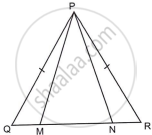
In ΔPQR, PQ = PR, QN = RM. Prove that ∠QPM = ∠RPN.
Advertisements
उत्तर
Given:
ΔPQR with PQ = PR Isosceles triangle with base QR
Points N and M on sides such that QN = RM
To prove: ∠QPM = ∠RPN
Step 1: Analyze the triangle
ΔPQR is isosceles with PQ = PR.
Let us draw segments PN and PM.
We want to prove that the angles at P formed by these segments are equal. That is, we want to show ∠QPM = ∠RPN.
Step 2: Consider triangles ΔQPM and ΔRPN
Observe triangles:
1. ΔQPM and ΔRPN
2. We are given:
PQ = PR ...(Sides of ΔPQR)
QN = RM ...(Given)
PM = PN ...(If we can show that PM = PN, then triangles are congruent by SSS)
Step 3: Use congruence criteria
Consider triangles ΔQPM and ΔRPN:
Sides:
PQ = PR ..(Given)
QN = RM ...(Given)
Side: PM = PN → If PM = PN, then ΔQPM ≅ ΔRPN by SSS
Then, the corresponding angles at P will be equal ∠QPM = ∠RPN
Step 4: Show PM = PN
Draw ΔPQR as isosceles with vertex P and base QR
Let PM and PN intersect points M on PR and N on PQ such that QN = RM
Observation:
Since PQ = PR and QN = RM, the segments PM and PN are symmetric w.r.t. the angle bisector of ∠P
Hence, PM = PN
Step 5: Apply SSS Congruence
Triangles ΔQPM and ΔRPN have:
1. PQ = PR ...(Given)
2. QN = RM ...(Given)
3. PM = PN ...(Symmetry)
By SSS congruence criterion ΔQPM ≅ ΔRPN
Step 6: Conclude angles are equal
Corresponding angles of congruent triangles are equal ∠QPM = ∠RPN.
