Advertisements
Advertisements
प्रश्न
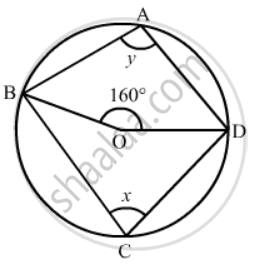
In the given figure, O is the centre of the circle. If ∠BOD = 160°, find the values of x and y.
Advertisements
उत्तर
It is given that O is centre of the circle and ∠BOD = 160°

We have to find the values of x and y.
As we know that the angle subtended by an arc of a circle at the centre is double the angle subtended by it at any point on the remaining part of the circle.
Therefore,
`x = 1/2 (160°)`
= 80°
Since, quadrilateral ABCD is a cyclic quadrilateral.
So,
x + y = 180° (Sum of opposite angles of a cyclic quadrilateral is 180°.)
` y = 180° - x`
=180° - 80°
= 100°
Hence `angle = 100° ` and `anglex = 80° `
APPEARS IN
संबंधित प्रश्न
In Fig. 8, O is the centre of a circle of radius 5 cm. T is a point such that OT = 13 cm and OT intersects circle at E. If AB is a tangent to the circle at E, find the length of AB, where TP and TQ are two tangents to the circle.

In fig., circles C(O, r) and C(O’, r/2) touch internally at a point A and AB is a chord of the circle C (O, r) intersecting C(O’, r/2) at C, Prove that AC = CB.
Write True or False. Give reason for your answer.
A circle is a plane figure.
In fig. a circle touches all the four sides of quadrilateral ABCD with AB = 6cm, BC = 7cm, CD = 4cm. Find AD.
In the given figure, a circle inscribed in a triangle ABC touches the sides AB, BC and CA at points D, E and F respectively. If AB = 14 cm, BC = 8 cm and CA = 12 cm. Find the lengths AD, BE and CF.

A quadrilateral is drawn to circumscribe a circle. Prove that the sums of opposite sides are equal.
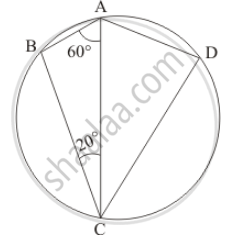
In the given figure, if ∠BAC = 60° and ∠BCA = 20°, find ∠ADC.
Two concentric circles are of diameters 30 cm and 18 cm. Find the length of the chord of the larger circle which touches the smaller circle.
In an equilateral triangle, prove that the centroid and center of the circum-circle (circumcentre) coincide.
The center of a circle is at point O and its radius is 8 cm. State the position of a point P (point P may lie inside the circle, on the circumference of the circle, or outside the circle), when:
(a) OP = 10.6 cm
(b) OP = 6.8 cm
(c) OP = 8 cm
