Advertisements
Advertisements
प्रश्न
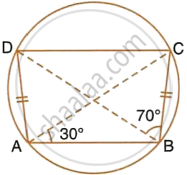
In the figure, given below, AD = BC, ∠BAC = 30° and ∠CBD = 70°.
Find:
- ∠BCD
- ∠BCA
- ∠ABC
- ∠ADB
Advertisements
उत्तर
In the figure, ABCD is a cyclic quadrilateral
AC and BD are its diagonals
∠BAC = 30° and ∠CBD = 70°
Now we have to find the measure of
∠BCD, ∠BCA, ∠ABC and ∠ADB
We have ∠CAD = ∠CBD = 70° ...[Angles in the same segment]
Similarly, ∠BAD = ∠BDC = 30°
∴ ∠BAD = ∠BAC + ∠CAD
= 30° + 70°
= 100°
i. Now ∠BCD + ∠BAD = 180° ...[Opposite angles of cyclic quadrilateral]
`=>` ∠BCD + ∠BAD = 180°
`=>` ∠BCD + 100° = 180°
`=>` ∠BCD = 180° – 100°
`=>` ∠BCD = 80°
ii. Since AD = BC,
ABCD is an isosceles trapezium and AB || DC
∠BAC = ∠DCA ...[Alternate angles]
`=>` ∠DCA = 30°
∴ ∠ABD = ∠DAC = 30° ...[Angles in the same segment]
∴ ∠BCA = ∠BCD – ∠DAC
= 80° – 30°
= 50°
iii. ∠ABC = ∠ABD + ∠CBD
= 30° + 70°
= 100°
iv. ∠ADB = ∠BCA = 50° ...[Angles in the same segment]
