Advertisements
Advertisements
प्रश्न
In an isosceles triangle ABC, sides AB and AC are equal. If point D lies in base BC and point E lies on BC produced (BC being produced through vertex C), prove that:
(i) AC > AD
(ii) AE > AC
(iii) AE > AD
Advertisements
उत्तर
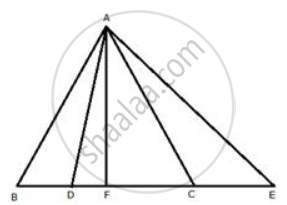
We know that the bisector of the angle at the vertex of an isosceles triangle bisects the base at the right angle.
Using Pythagoras theorem in AFB,
AB2 = AF2 + BF2 ...(i)
In AFD,
AD2 = AF2 + DF2 ...(ii)
We know ABC is isosceles triangle and AB = AC
AC2 = AF2 + BF2 ..(iii)[ From (i)]
Subtracting (ii) from (iii)
AC2 - AD2 = AF2 + BF2 - AF2 - DF2
AC2 - AD2 = BF2 - DF2
Let 2DF = BF
AC2 - AD2 = (2DF)2 - DF2
AC2 - AD2 = 4DF2 - DF2
AC2 = AD2 + 3DF2
⇒ AC2 > AD2
⇒ AC > AD
Similarly, AE > AC and AE > AD.
संबंधित प्रश्न
In triangle ABC, AB > AC and D is a point inside BC.
Show that: AB > AD.
Given: ED = EC
Prove: AB + AD > BC.
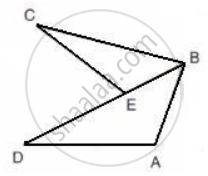
In triangle ABC, side AC is greater than side AB. If the internal bisector of angle A meets the opposite side at point D,
prove that: ∠ADC is greater than ∠ADB.
In quadrilateral ABCD, side AB is the longest and side DC is the shortest.
Prove that: C > A.
In quadrilateral ABCD, side AB is the longest and side DC is the shortest.
Prove that: D > B.
In the following figure; AB is the largest side and BC is the smallest side of triangle ABC.
Write the angles xo, yo and zo in ascending order of their values.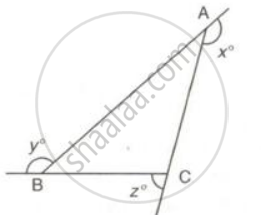
In the following diagram; AD = AB and AE bisect angle A. 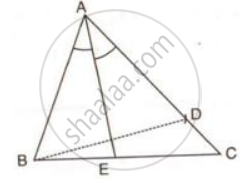
Prove that:
(i) BE = DE
(ii) ∠ABD > ∠C
P is any point inside the triangle ABC.
Prove that: ∠BPC > ∠BAC.
In the following figure, ABC is an equilateral triangle and P is any point in AC;
prove that: BP > PC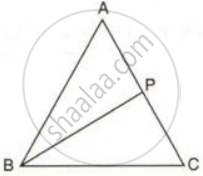
In a quadrilateral ABCD; prove that:
(i) AB+ BC + CD > DA
(ii) AB + BC + CD + DA > 2AC
(iii) AB + BC + CD + DA > 2BD
