Advertisements
Advertisements
प्रश्न
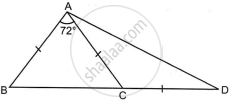
In ΔABC, BC is produced to D so that AB = AC = CD. If ∠BAC = 72°, find the angles of ΔABD and arrange its sides in ascending order of length.
योग
Advertisements
उत्तर
Given:
- In ΔABC, BC is produced to D such that AB = AC = CD,
- ∠BAC = 72°
To find:
- Angles of ΔABD,
- Arrange sides of ΔABD in ascending order of length.
Step 1: ΔABC
AB = AC, so ΔABC is isosceles.
∠BAC = 72°.
Therefore,
∠ABC = ∠ACB = `(180^circ - 72^circ)/2 = 54^circ`
Step 2: ΔACD
Since BC is extended to D, ∠ACD is an exterior angle to ΔABC.
∠ACD = 180° − ∠ACB = 180° − 54° = 126°
In ΔACD, AC = CD (isosceles)
Base angles are equal:
∠CAD = ∠CDA = `(180^circ - 126^circ)/2 = 27^circ`
Step 3: ΔABD
∠ABD = ∠ABC = 54°.
∠CAD = 27°, and ∠BAC = 72°, so
∠BAD = 72° + 27° = 99°
Now,
∠ADB = 180° − (99° + 54°) = 27°
Step 4: Order of sides
- The smallest side is opposite 27° → AB.
- The next side is opposite 54° → AD.
- The largest side is opposite 99° → BD.
So, AB < AD < BD
shaalaa.com
क्या इस प्रश्न या उत्तर में कोई त्रुटि है?
