Advertisements
Advertisements
प्रश्न
In a class of 50 students, each one come to school by bus or by bicycle or on foot. 25 by bus, 20 by bicycle, 30 on foot and 10 students by all the three. Now how many students come to school exactly by two modes of transport?
Advertisements
उत्तर
Let B, C and D represent students come to school by bus, bicycle and foot respectively.
n(B ∪ C ∪ D) = 50, n(B) = 25, n(C) = 20, n(D) = 30, n(B ∩ C ∩ D) = 10
Let x, y and z represent the students come to school exactly by two modes of transport.
Let us represent the given data in Venn diagrams.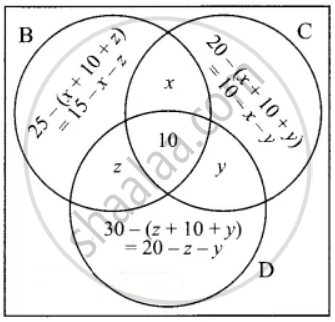
Total number of students in the class = 50
15 – x – z + x + 10 – x – y + y + 10 + z + 20 – z – y = 50
55 – x – y – z = 50
55 – 50 = x + y + z
5 = x + y + z
Number of students come to school exactly by two modes of transport = 5
APPEARS IN
संबंधित प्रश्न
State, whether the pair of sets, given below, are equal sets or equivalent sets:
{7, 7, 2, 1,2} and {1, 2, 7}
Write the cardinal number of the following set:
C = { }
Given:
A = {Natural numbers less than 10}
B = {Letters of the word ‘PUPPET’}
C = {Squares of first four whole numbers}
D = {Odd numbers divisible by 2}.
Find: n(B)
Given:
A = {Natural numbers less than 10}
B = {Letters of the word ‘PUPPET’}
C = {Squares of first four whole numbers}
D = {Odd numbers divisible by 2}.
Find: n(B ∪ D)
Given:
A = {Natural numbers less than 10}
B = {Letters of the word ‘PUPPET’}
C = {Squares of first four whole numbers}
D = {Odd numbers divisible by 2}.
Find: n(B ∪ C)
Out of 500 car owners investigated, 400 owned car A and 200 owned car B, 50 owned both A and B cars. Is this data correct?
In a colony, 275 families buy Tamil newspaper, 150 families buy English newspaper, 45 families buy Hindi newspaper, 125 families buy Tamil and English newspaper, 17 families buy English and Hindi newspapers, 5 families buy Tamil and Hindi newspaper and 3 families buy all the three newspaper. If each family buy atleast one of these newspaper then find Number of families buy only one newspaper
A survey of 1000 farmers found that 600 grew paddy, 350 grew ragi, 280 grew corn, 120 grew paddy and ragi, 100 grew ragi and corn, 80 grew paddy and corn. If each farmer grew atleast anyone of the above three, then find the number of farmers who grew all the three.
What is the cardinal number of an empty set?
If Set A has the unique elements {2, 3, 5}, which of the following correctly represents its cardinality?
