Advertisements
Advertisements
प्रश्न
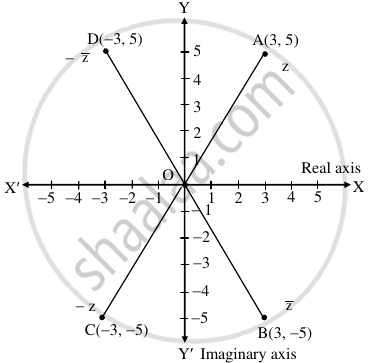
If z = 3 + 5i then represent the `"z", bar("z"), - "z", bar(-"z")` in Argand's diagram
Advertisements
उत्तर
If z = 3 + 5i, then
`bar"z"` = 3 – 5i,
– z = – 3 – 5i and
`-bar("z")` = – 3 + 5i
The above complex numbers will be represented by the points A(3, 5), B(3, –5), C(–3, –5), D(–3, 5) respectively as shown below:
APPEARS IN
संबंधित प्रश्न
Find the modulus and amplitude of the following complex numbers.
7 − 5i
Find the modulus and amplitude of the following complex numbers.
`sqrt(3) + sqrt(2)"i"`
Find the modulus and amplitude of the following complex numbers.
−3(1 − i)
Find the modulus and amplitude of the following complex number.
−4 − 4i
Find the modulus and amplitude of the following complex numbers.
3
Find the modulus and amplitude of the following complex numbers.
1 + i
Find the modulus and amplitude of the following complex numbers.
`1 + "i"sqrt(3)`
Express the following complex numbers in polar form and exponential form:
− i
Express the following complex numbers in polar form and exponential form:
−1
Express the following complex numbers in polar form and exponential form:
`(1 + 2"i")/(1 - 3"i")`
Express the following numbers in the form x + iy:
`sqrt(2)(cos (7pi)/4 + "i" sin (7pi)/4)`
Express the following numbers in the form x + iy:
`"e"^((-4pi)/3"i")`
Express the following numbers in the form x + iy:
`"e"^((5pi)/6"i")`
Find the modulus and argument of the complex number `(1 + 2"i")/(1 - 3"i")`
For z = 2 + 3i verify the following:
`"z"bar("z")` = |z|2
z1 = 1 + i, z2 = 2 − 3i. Verify the following :
`bar("z"_1 + "z"_2) = bar("z"_1) + bar("z"_2)`
z1 = 1 + i, z2 = 2 − 3i. Verify the following :
`bar("z"_1 - "z"_2) = bar("z"_1) - bar("z"_2)`
z1 = 1 + i, z2 = 2 − 3i. Verify the following :
`bar(("z"_1/"z"_2))=bar("z"_1)/bar("z"_2)`
Select the correct answer from the given alternatives:
The modulus and argument of `(1 + "i"sqrt(3))^8` are respectively
Select the correct answer from the given alternatives:
If arg(z) = θ, then arg `bar(("z"))` =
Select the correct answer from the given alternatives:
If `-1 + sqrt(3)"i"` = reiθ , then θ = .................
Answer the following:
Find the modulus and argument of a complex number and express it in the polar form.
8 + 15i
Answer the following:
Find the modulus and argument of a complex number and express it in the polar form.
`(1 + sqrt(3)"i")/2`
Answer the following:
Find the modulus and argument of a complex number and express it in the polar form.
`(-1 - "i")/sqrt(2)`
Answer the following:
Find the modulus and argument of a complex number and express it in the polar form.
− 3i
Answer the following:
Find the modulus and argument of a complex number and express it in the polar form.
`1/sqrt(2) + 1/sqrt(2)"i"`
Answer the following:
Convert the complex numbers in polar form and also in exponential form.
z = `-6 + sqrt(2)"i"`
Convert the complex numbers in polar form and also in exponential form.
`(-3)/2 + (3sqrt(3))/2"i"`
The modulus of z = `sqrt7` + 3i is ______
The modulus and amplitude of 4 + 3i are ______
If x + iy = `5/(3 + costheta + isintheta)`, then x2 + y2 is equal to ______
If z = `5i ((-3)/5 i)`, then z is equal to 3 + bi. The value of ‘b’ is ______.
If z = `π/4(1 + i)^4((1 - sqrt(π)i)/(sqrt(π) + i) + (sqrt(π) - i)/(1 + sqrt(π)i))`, then `(|z|/("amp"^((z))))` is equals to ______.
