Advertisements
Advertisements
प्रश्न
If y = f(x) is a differentiable function of x such that inverse function x = f–1 (y) exists, then prove that x is a differentiable function of y and `dx/dy=1/((dy/dx)) " where " dy/dx≠0`
Advertisements
उत्तर १
Let `delta`y be the increment in y corresponding to an increment `delta`x in x.
as `deltax->0,deltay->0`
Now y is a differentiable function of x.
`therefore lim_(deltax->0)(deltay)/(deltax)=dy/dx`
Now `(deltay)/(deltax)xx(deltax)/(deltay)=1`
`therefore (deltax)/(deltay)=1/((deltay)/(deltax))`
Taking limits on both sides as `deltax->0, we get`
`lim_(deltax->0)(deltax)/(deltay)=lim_(deltax->0)[1/((deltay)/(deltax))]=1/(lim_(dx->0)(deltay)/(deltax))`
`lim_(deltax->0)(deltax)/(deltay)=1/(lim_(dx->0)(deltay)/(deltax))` ....[as `deltax->0,deltay->0`]
Since limit in R.H.S. exists
limit in L.H.S. also exists and we have,
`lim_(deltay->0)(deltax)/(deltay)=dx/dy`
`dx/dy=1/(dy/dx)`, where `dy/dxne0`
Let `y=tan^-1x`
`x=tany=>cosy=1/sqrt(1+tan^2y)=1/sqrt(1+x^2)`
`therefore sec^y.dy/dx=1=>dx/dy=sec^2y`
`dy/dx=1/(dx/dy)=1/sec^2y=cos^2y=>dy/dx=cos^y`
`(d(tan^-1x))/dx=cos^2y=(cosy)^2=(1/sqrt(1+x^2))^2`
`therefore d/dx(tan^-1x)=1/(1+x^2)`
उत्तर २
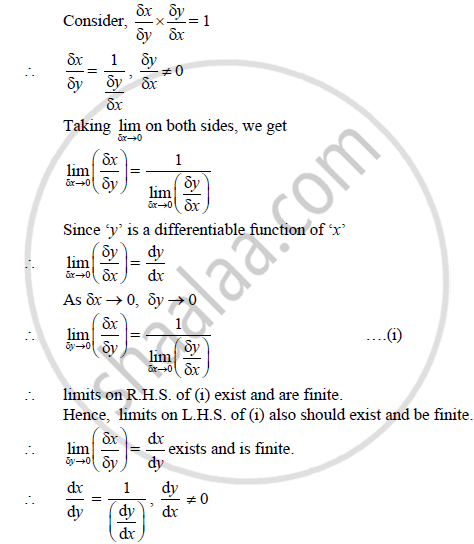
'y’ is a differentiable function of ‘x’.
Let there be a small change δx in the value of ‘x’.
Correspondingly, there should be a small change δy in the value of ‘y’.
As δx → 0, δy → 0
संबंधित प्रश्न
If `y=cos^-1(2xsqrt(1-x^2))`, find dy/dx
Find `dy/dx if y=cos^-1(sqrt(x))`
If `y=sec^-1((sqrtx-1)/(x+sqrtx))+sin_1((x+sqrtx)/(sqrtx-1)), `
(A) x
(B) 1/x
(C) 1
(D) 0
If y = f (x) is a differentiable function of x such that inverse function x = f –1(y) exists, then
prove that x is a differentiable function of y and
`dx/dy=1/(dy/dx)`, Where `dy/dxne0`
Hence if `y=sin^-1x, -1<=x<=1 , -pi/2<=y<=pi/2`
then show that `dy/dx=1/sqrt(1-x^2)`, where `|x|<1`
If `x^y = e^(x - y)` , show that `(dy)/(dx) = logx/(1 + logx)^2`
If `x^y = e^(x - y)` , show that `(dy)/(dx) = logx/(1 + logx)^2`
The total cost function of a firm is C = x2 + 75x + 1600 for output x. Find the output for which the average cost ls minimum. Is CA= Cm at this output?
If \[y=f(x)\] is a differentiable function of \[x\] and the inverse function \[x=f^{-1}(y)\] exists, which expression gives \[\frac{\mathrm{d}x}{\mathrm{d}y}\]?
What condition is required for \[\frac{\mathrm{d}x}{\mathrm{d}y}=\frac{1}{\left(\frac{\mathrm{d}y}{\mathrm{d}x}\right)}\]?
The derivative of an inverse function is usually found using which method?
Which expression is the derivative of \[\sin^{-1}(f(x))\] when \[|f(x)|<1\]?
Which derivative and condition are correct for \[\cos^{-1}x\]?
Which expression is the derivative of \[\cos^{-1}(f(x))\] when \[|f(x)|<1\]?
Which derivative and condition are correct for \[\tan^{-1}x\]?
Which derivative and condition are correct for \[\cot^{-1}x\]?
Which expression is the derivative of \[\cot^{-1}(f(x))\] when \[f(x)\in\mathbb{R}\]?
Which derivative and condition are correct for \[\sec^{-1}x\]?
Which expression is the derivative of \[\sec^{-1}(f(x))\] when \[|f(x)|>1\]?
Which derivative and condition are correct for \[\operatorname{cosec}^{-1}x\]?
Which expression is the derivative of \[\operatorname{cosec}^{-1}(f(x))\] when \[|f(x)|>1\]?
Differentiating \[x=\sin y\] with respect to \[x\] gives which equation?
Using \[\sin^2y+\cos^2y=1\] and \[\sin y=x\], what is \[\cos^2y\]?
For \[y\in\left(-\frac{\pi}{2},\frac{\pi}{2}\right)\], which value of \[\cos y\] follows from \[\cos^2y=1-x^2\]?
Which inverse functions have denominator \[\sqrt{1-x^2}\] in their derivatives?
For which inverse functions are negative signs especially important?
What must be checked before applying derivative formulas for inverse functions?
