Advertisements
Advertisements
प्रश्न
If the point A(x, y) is equidistant from the points B(–2, 0) and C(2, 0), prove that the point A lies on y-axis. Also, find the coordinates of the point A, if ΔABC is an equilateral triangle.
Advertisements
उत्तर
1. Prove A lies on the y-axis
Since point A(x, y) is equidistant from B(–2, 0) and C(2, 0), the distances AB and AC are equal.
Using the distance formula `sqrt((x_2 - x_1)^2 + (y_2 - y_1)^2)`:
`AB = sqrt((x - (-2))^2 + (y - 0)^2)`
= `sqrt((x + 2)^2 + y^2)`
`AC = sqrt((x - 2)^2 + (y - 0)^2)`
= `sqrt((x - 2)^2 + y^2)`
Since AB = AC, their squares are also equal:
(x + 2)2 + y2 = (x – 2)2 + y2
Expanding both sides:
x2 + 4x + 4 + y2 = x2 – 4x + 4 + y2
4x = –4x
⇒ 8x = 0
⇒ x = 0
Any point with an x-coordinate of 0 lies on the y-axis.
2. Find coordinates for an equilateral triangle
In an equilateral triangle, all sides are equal.
First, find the length of the base BC:
`BC = sqrt((2 - (-2))^2 + (0 - 0)^2)`
= `sqrt(4^2)`
= 4 units
Since the triangle is equilateral, AB = BC = 4.
Using the distance AB with x = 0:
`sqrt((0 + 2)^2 + (y - 0)^2) = 4`
22 + y2 = 42
4 + y2 = 16
⇒ y2 = 12
`y = ± sqrt(12)`
= `± 2sqrt(3)`
The coordinates of point A are either `(0, 2sqrt(3))` or `(0, -2sqrt(3))`.
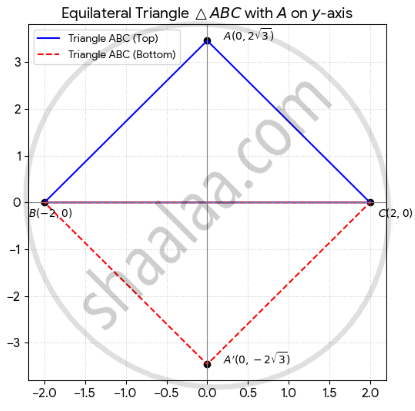
The point A lies on the y-axis because its x-coordinate must be 0 to be equidistant from B(–2, 0) and C(2, 0) and its coordinates in an equilateral triangle are `(0, 2sqrt(3))` or `(0, -2sqrt(3))`.
