Advertisements
Advertisements
प्रश्न
If the angle of elevation of a cloud from a point ‘h’ metres above a lake is θ1 and the angle of depression of its reflection in the lake is θ2. Prove that the height that the cloud is located from the ground is `("h"(tan theta_1 + tan theta_2))/(tan theta_2 - tan theta_1)`
Advertisements
उत्तर
Let P be the cloud and Q be its reflection.
Let A be the point of observation such that AB = h
Let the height of the cloud be x. ...(PS = x)
PR = x – h and QR = x + h
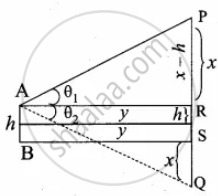
Let AR = y
In the right ∆ARP, tan θ1 = `"PR"/"AR"`
tan θ1 = `(x - "h")/y` ...(1)
In the ∆AQR,
tan θ2 = `"QR"/"AR"`
tan θ2 = `(x + "h")/y` ...(2)
Add (1) and (2)
tan θ1 + tan θ2 = `(x - "h")/y + (x + "h")/y`
= `(x - "h" + x + "h")/y`
= `(2x)/y`
Subtract (2) and (1)
tan θ2 − tan θ1 = `(x + "h")/y - (x - "h")/y`
= `(x + "h" - x + "h")/y`
= `(2"h")/y`
`((tan theta_1 + tan theta_2))/(tan theta_2 - tan theta_1) = (2x)/y ÷ (2"h")/y`
= `(2x)/y xx y/(2"h")`
= `x/"h"`
∴ x = `("h"(tan theta_1 + tan theta_2))/(tan theta_2 - tan theta_1)`
Hence the proof.
