Advertisements
Advertisements
प्रश्न
If tan θ = `20/21` show that `((1-sin θ + cos θ))/((1+ sin θ +cos θ)) = 3/7`
Advertisements
उत्तर
Let us consider a right ΔABC right angled at B and ∠𝐶 = 𝜃
Now, we know that tan 𝜃 = `(AB)/(BC) = 20/21`
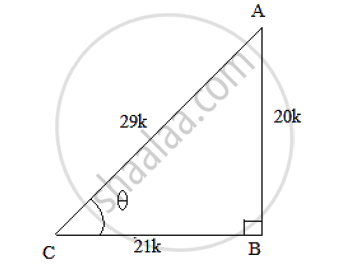
So, if AB = 20k, then BC = 21k, where k is a positive number.
Using Pythagoras theorem, we get:
`AC^2 = AB^2 + BC^2`
`⟹ AC^2 = (20K)^2 + (21K)^2`
`⟹ AC^2 = 841K^2`
⟹ 𝐴𝐶 = 29𝑘
Now. Sin 𝜃 = `(AB)/(AC) = 20/29 and cos θ =(BC)/(AC)=21/29`
Substituting these values in the give expression, we get:
LHS = `(1- sin θ + cos θ )/(1+ sin θ + cos θ )`
=` (1-20/29+21/29)/(1+20/29+21/29)`
=` ((29-20+21)/29)/((29+20+21)/29) = 30/70 = 3/7 = `𝑅𝐻𝑆
∴ LHS = RHS
Hence proved.
shaalaa.com
क्या इस प्रश्न या उत्तर में कोई त्रुटि है?
