Advertisements
Advertisements
प्रश्न
If sin A = `(sqrt3)/(2)` and cos B = `(sqrt3)/(2)` , find the value of : `(tan"A" – tan"B")/(1+tan"A" tan"B")`
Advertisements
उत्तर
Consider the diagram below :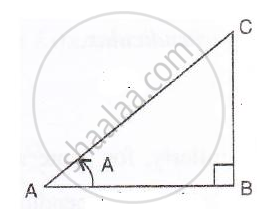 'in A = `(sqrt3)/(2)`
i.e.`"perpendicular"/"hypotenuse" = (sqrt3)/(2) ⇒"BC"/"AC" = (sqrt3)/(2)`
Therefore if length of BC = `sqrt3x`, length of AC = 2x
Since
AB2 + BC2 = AC2 ...[ Using Pythagoras Therorm]
`(sqrt3x)^2 + AB^2 = (2x)^2`
AB2 = x2
∴ AB = x (base)
Consider the diagram below :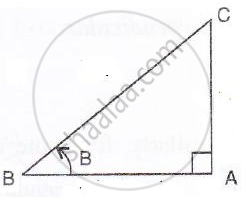
cos B = `(sqrt3)/(2)`
i.e.`"base"/"perpendicular" = (sqrt3)/(2) ⇒ "AB"/"BC" = (sqrt3)/(2)`
Therefore if length of AB = `sqrt3x` , length of BC = 2x
Since
AB2 + AC2 = BC2 ...[ Using Pythagoras Theorem ]
AC2 + `(sqrt3x)^2 = (2x)^2`
AC2 = x2
∴ AC = x(perpendicular)
Now
tan A = `"perpendicular"/"base" = (sqrt3x)/(x) = sqrt3`
tan B = `"perpendicular"/"base" = (x)/(sqrt3x) = 1/(sqrt3)`
Therefore
`(tan A – tan B)/(1 + tan A tan B) = (sqrt3 - 1/(sqrt3))/(1+sqrt3 1/(sqrt3)`
= `((2)/(sqrt3))/(2)`
= `(1)/(sqrt3)`
