Advertisements
Advertisements
प्रश्न
If points A(–5, y), В(2, –2), C(8, 4) and D(x, 5) taken in order, form a parallelogram ABCD, then find the values of x and y. Hence, find the lengths of the sides of the parallelogram.
Advertisements
उत्तर
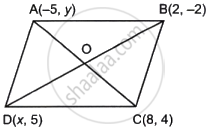
We know that diagonals of a parallelogram bisect each other.
So, the coordinates of the midpoint of AC = coordinates of the midpoint of BD.
`(∵ "x- coordinate of O" = (x_1 + x_2)/2 = "y-coordinate of O" = (y_1 + y_2)/2)`
⇒ `((-5 + 8)/2, (y + 4)/2) = ((2 + x)/2, (-2 + 5)/2)`
⇒ `(3/2, (y + 4)/2) = ((x + 2)/2, 3/2)`
⇒ `3/2 = (x + 2)/2`
⇒ 2(x + 2) = 3 × 2 ...(By cross multiplying)
⇒ 2x + 4 = 6
⇒ 2x = 6 – 4
⇒ `x = 2/2`
⇒ x = 1
And `(y + 4)/2 = 3/2`
⇒ 2(y + 4) = 3 × 2 ...(By cross multiplying)
⇒ 2y + 8 = 6
⇒ 2y = 6 – 8
⇒ `y = (-2)/2`
⇒ y = –1
Therefore, the value of x = 1 and y = –1.
To find the lengths of the sides of the parallelogram, we use the distance formula.
We know that in the parallelogram ABCD
AB = CD and BC = AD
So, the lengths of sides
AB = `sqrt((x_2 - x_1)^2 + (y_2 - y_1)^2`
= `sqrt([2 - (-5)]^2 + [(-2) - (-1)^2]`
= `sqrt((2 + 5)^2 + (-2 + 1)^2`
= `sqrt((7)^2 + (-1)^2`
= `sqrt(49 + 1)`
= `sqrt(50)`
= `5sqrt(2)`
And BC = `sqrt((8 - 2)^2 + [4 - (-2)]^2`
= `sqrt((6)^2 + (4 + 2)^2`
= `sqrt(36 + (6)^2`
= `sqrt(36 + 36)`
= `sqrt(72)`
= `6sqrt(2)`
Therefore, the lengths of sides of the parallelogram are AB = CD = `5sqrt(2)` and BC = AD = `6sqrt(2)`.
