Advertisements
Advertisements
प्रश्न
If E is a point on side CA of an equilateral triangle ABC such that BE ⊥ CA, then AB2 + BC2 + CA2 =
विकल्प
2 BE2
3 BE2
4 BE2
6 BE2
MCQ
Advertisements
उत्तर
In triangle ABC, E is a point on AC such that `BE ⊥ AC`.
We need to find `AB^2+BC^2+AC^2`.
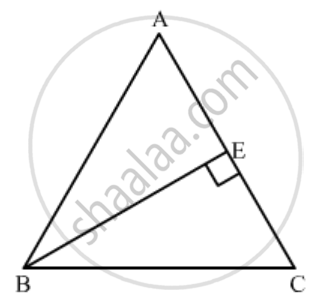
Since `BE ⊥ AC`, CE = AE =
\[\frac{AC}{2}\](In a equilateral triangle, the perpendicular from the vertex bisects the base.)
In triangle ABE, we have
`AB^2 = BE^2+AE^2`
Since AB = BC = AC
Therefore, `AB^2=BC^2=AC^2=BE^2+AE^2`
Since in triangle BE is an altitude, so `BE = (sqrt3)/2 AB`
`BE = (sqrt3)/2 AB`
`(sqrt3)/2 xxAC`
`(sqrt3)/2 xx 2AE= sqrt3AE`
`⇒ AB^2 + BC^2+AC^2= 3BE^2+3((BE)/sqrt3)^2`
`= 3BE^2+BE^2=4BE^2`
Hence option (c) is correct.
shaalaa.com
क्या इस प्रश्न या उत्तर में कोई त्रुटि है?
