Advertisements
Advertisements
प्रश्न
If 4 tan θ = 3, evaluate `((4sin theta - cos theta + 1)/(4sin theta + cos theta - 1))`
योग
Advertisements
उत्तर
Given: 4 tan θ = 3 ⇒ tan θ = 3/4
Let us suppose a right angle triangle ABC right angled at B, with one of the acute angle θ. Let the sides be BC = 3k and AB = 4k, where k is a positive number
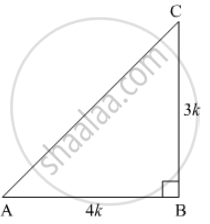
By Pythagoras theorem, we get
AC2 = BC2 + AB2
AC2 = (3k)2 + (4k)2
AC2 = 9k2 + 16k2
AC = `sqrt(25k^2)`
AC = ± 5k
Ignoring AC = −5k, as k is a positive number, we get
AC = 5k
if `tan theta = (BC)/(AB) = 3/4` then `sin theta = (BC)/(AC) = 3/5` and `cos theta = (AB)/(AC) = 4/5`
Putting the values in `((4 sin theta - cos theta + 1)/(4 sin theta + cos theta - 1))` we get
`((4xx3/5 - 4/5 + 1)/(4xx 3/5 + 4/5 -1))`
= `(((12- 4 + 5)/5)/((12 + 4 - 5)/5))`
= `13/11`
shaalaa.com
क्या इस प्रश्न या उत्तर में कोई त्रुटि है?
