Advertisements
Advertisements
प्रश्न
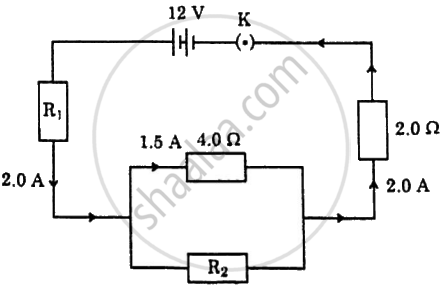
- The given electric circuit is a part of an electrical device. Use the information given in the electric circuit diagram to calculate:
- Potential difference across the ends of resistor R2.
- Value of resistor R1.
-
Write the factors on which resistance of a conductor depends and derive the formula for resistance of a given conductor.
Advertisements
उत्तर
i. I. Potential difference across R2:
Current in main branch = 2.0 A
Current through 4 Ω resistor = 1.5 A
⇒ Current through R2 = 2.0 − 1.5
= 0.5 A
Potential difference across 4 Ω:
V = IR
= 1.5 × 4
= 6 V
Since R2 is in parallel with a 4 Ω resistor:
`V_(R_2)` = 6 V
II. Value of R1:
Apply KVL in the outer loop:
Battery voltage = 12 V
Voltage drop across:
2 Ω resistor:
V = 2 × 2
= 4 V
Parallel section = 6 V
Let drop across R1 = V1
12 = V1 + 6 + 4
⇒ V1 = 2 V
R1 = `V_1/I`
= `2/2`
= 1 Ω
ii. Resistance ∝ Length:
R ∝ L
R ∝ `1/A`
R ∝ `L/A`
R = `rho L/A`
Factors affecting the resistance are length (L), area of cross-section (A), nature of material (resistivity, ρ), and temperature.
