Advertisements
Advertisements
प्रश्न
How will you separate camphor, common salt and iron nails from their mixture ?
Advertisements
उत्तर
We will use the following methods to separate camphor, common salt and iron nails from their mixture:
Take the mixture and pour it in a beaker of water. On stirring, salt will dissolve, while iron nails and camphor will not. Fold a fluted piece of filter paper and put it on the funnel. Then filter the mixture to another beaker. The salt solution will pass through and iron filings and camphor will remain on the paper. Put the filtrate into an evaporating dish and heat it over a Bunsen burner so that the water will evaporate. Eventually, salt will be left behind. Pass the magnet over the camphor and iron filings. The magnet will attract the iron, leaving behind camphor as residue.
APPEARS IN
संबंधित प्रश्न
The molecules can move freely anywhere in
Differentiate between an atom and a molecule.
Name the terms for the particles of matter which may or may not have independent existence.
What are the conditions for 'something' to be called 'matter'?
Name two processes which provide the best evidence for the motion of particles in matter.
When a gas jar containing air is inverted over a gas jar containing bromine vapour, the red-brown bromine vapour diffuse into air. Explain how bromine vapour diffuse into air.
Name the property which allows metals to be hammered into thin sheets.
Name the property which enables metals to be drawn into wires.
What is the name of the clear liquid formed when a solid dissolves in a liquid ?
What happens when the temperature of a saturated sugar solution is increased ?
What will happen if a saturated solution is :
- heated
- cooled
What is a suspension ? Give two examples of suspensions.
When the solid A is added to water, it dissolves with the evolution of a lot of heat and making little explosions to form two products B and C. The properties of products B and C are entirely different from those of solid A as well as water. Moreover, products B and C cannot be reconverted into solid A and water. When another solid D is added to water, it dissolves with the absorption of a little heat to form a product E which cools down. The product E shows the properties of both, solid D as well as water. Moreover, product E can be converted into solid D and water.
(a) What type of change occurs when solid A is dissolved in water ? Why ?
(b) What type of change occurs when solid D is dissolved in water ? Why ?
(c) Name a metal which you think could behave like solid A. Also name the products B and C.
(d) Name the solid D if it is the one which is used in making ordinary dry cells.
(e) Name the process by which D can be recovered from E.
What difference in the property of two miscible liquids enables their separation by fractional distillation ?
How would you separate iodine from a mixture of iodine and common salt ?
How will you separate a mixture of iron filings, chalk powder and common salt ?
Justify your answer.
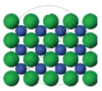
| Figure 1 | Figure 2 | Figure 3 |
 |
 |
 |
The arrangement of particles in three different phases of matter is shown above.
- Which state is represented by Fig. 1?
- In which state will the inter-particle attraction be maximum?
- Which one of them cannot be contained in an open vessel?
- Which one can take the shape of its container?
Why wires cannot be drawn from materials such as stone or wood?
Atoms or groups of atoms having a charge are called ______.
