Advertisements
Advertisements
प्रश्न
Four alternative answers for the following question is given. Choose the correct alternative.
Points A, B, C are on a circle, such that m(arc AB) = m(arc BC) = 120°. No point, except point B, is common to the arcs. Which is the type of ∆ABC?
विकल्प
Equilateral triangle
Scalene triangle
Right angled triangle
Isosceles triangle
Advertisements
उत्तर
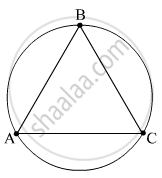
m(arc AB) = m(arc BC) = 120º
Now,
m(arc AB) + m(arc BC) + m(arc CA) = 360º
⇒ 120º + 120º + m(arc CA) = 360º
⇒ 240º + m(arc CA) = 360º
⇒ m(arc CA) = 360º − 240º = 120º
∴ m(arc AB) = m(arc BC) = m(arc CA)
⇒ arc AB ≅ arc BC ≅ arc CA ......(Two arcs are congruent if their measures are equal)
⇒ chord AB ≅ chord BC ≅ chord CA ......(Chords corresponding to congruent arcs of a circle are congruent)
∴ ∆ABC is an equilateral triangle. ......(All sides of equilateral triangle are equal)
Hence, the correct answer is option Equilateral triangle.
