Advertisements
Advertisements
प्रश्न
(For this question, use a graph paper. Scale: 2 cm = 1 unit along both x and y-axis.)
Plot the points A(2, 2) and B(6, –2) in the graph and answer the following:
- Reflect points A in origin to point D and write the co-ordinates of point D.
- Reflect points A in line y = –2 to point C and write the co-ordinates of points C.
- Find a point P on CD which is invariant under reflection in x = 0, write its co-ordinates.
- Write the geometrical name of the closed figure ABCD.
- Write the co-ordinates of the point of intersection of the diagonals of ABCD.
Advertisements
उत्तर
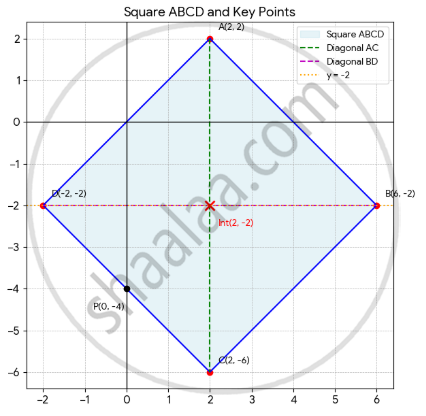
1. Reflect A in the origin
The rule for reflection in the origin is (x, y) → (–x, –y).
Reflecting A(2, 2) gives D(–2, –2).
2. Reflect A in line y = –2
To reflect a point (x, y) in a horizontal line y = k, the x-coordinate remains same and the new y-coordinate is 2k – y.
Here, k = –2 and A = (2, 2)
y’ = 2(–2) – 2
= –4 – 2
= –6
The coordinates of C is (2, –6).
3. Find invariant point P on CD
A point is invariant under reflection in x = 0 the y-axis if its x-coordinate is 0.
Line CD connects C(2, –6) and D(–2, –2). The midpoint of CD lies on the y-axis: `x = (2 + (-2))/2 = 0`.
The corresponding y-coordinate is `(-6 + (-2))/2 = -4`.
Point P is (0, –4).
Calculate side lengths: All sides (AB, BC, CD, DA) equal `sqrt(32) ≈ 5.66` units.
Check slopes: The product of slopes of adjacent sides e.g., AB and BC is –1, indicating they are perpendicular.
Thus, ABCD is a square.
5. Intersection of diagonals
Midpoint of `AC = ((2 + 2)/2, (2 - 6)/2) = (2, -2)`.
The coordinates are D(–2, –2), C(2, –6), P(0, –4) and the intersection of diagonals is (2, –2) the figure ABCD is a square.
