हिंदी

Find the Vector Equation of the Line Passing Through (1, 2, 3) and Parallel to the Planes Vecr = (Hati - Hatj + 2hatk) = 5`And Vecr.(3hati + Hatj + Hatk) = 6 - Mathematics

Advertisements
Advertisements

प्रश्न

Find the vector equation of the line passing through (1, 2, 3) and parallel to the planes `vecr = (hati - hatj + 2hatk)  = 5`and `vecr.(3hati + hatj + hatk) = 6`

Advertisements

उत्तर

Let the required line be parallel to vector `vecb` given by,

`vecb = b_1hati + b_2hatj + b_3hatk`

The position vector of the point (1, 2, 3) is `veca = hati + 2hatj + 3hatk`

The equation of line passing through (1, 2, 3) and parallel to `vecb`is given by,
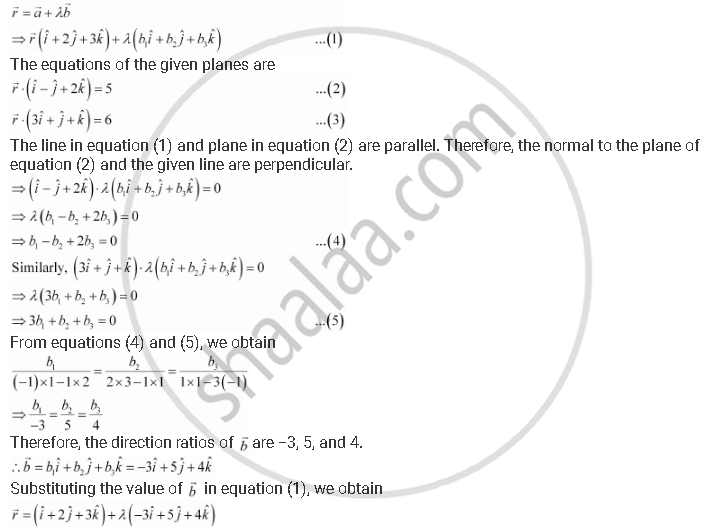
This is the equation of the required line.

shaalaa.com
  क्या इस प्रश्न या उत्तर में कोई त्रुटि है?
अध्याय 11: Three Dimensional Geometry - Exercise 11.4 [पृष्ठ ४९९]

APPEARS IN

एनसीईआरटी Mathematics Part 1 and 2 [English] Class 12
अध्याय 11 Three Dimensional Geometry
Exercise 11.4 | Q 19 | पृष्ठ ४९९

वीडियो ट्यूटोरियलVIEW ALL [1]

संबंधित प्रश्न

Find the vector equation of the line passing through the point (1, 2, − 4) and perpendicular to the two lines: 

`(x -8)/3 = (y+19)/(-16) = (z - 10)/7 and (x - 15)/3 = (y - 29)/8 = (z- 5)/(-5)`


Find the Cartesian form of the equation of a plane whose vector equation is 

  \[\vec{r} \cdot \left( - \hat{i} + \hat{j}  + 2 \hat{k} \right) = 9\]


Find the vector equation of each one of following planes. 

2x − y + 2z = 8


Find the vector and Cartesian equations of a plane passing through the point (1, −1, 1) and normal to the line joining the points (1, 2, 5) and (−1, 3, 1).


The coordinates of the foot of the perpendicular drawn from the origin to a plane are (12, −4, 3). Find the equation of the plane.


Show that the normals to the following pairs of planes are perpendicular to each other.

\[\vec{r} \cdot \left( 2 \hat{i}  - \hat{j}  + 3 \hat{k}  \right) = 5 \text{ and }  \vec{r} \cdot \left( 2 \hat{i}  - 2 \hat{j}  - 2 \hat{k}  \right) = 5\]

find the equation of the plane passing through the point (1, 2, 1) and perpendicular to the line joining the points (1, 4, 2) and (2, 3, 5). Find also the perpendicular distance of the origin from this plane


Find the vector equation of the plane passing through the points (1, 1, 1), (1, −1, 1) and (−7, −3, −5).


Find the vector equation of the plane passing through the points (1, 1, −1), (6, 4, −5) and (−4, −2, 3).


Find the equation of the plane passing through the points (2, 2, 1) and (9, 3, 6) and perpendicular to the plane 2x + 6y + 6z = 1.


Find the equation of the plane that contains the point (1, −1, 2) and is perpendicular to each of the planes 2x + 3y − 2z = 5 and x + 2y − 3z = 8.


Find the equation of the plane passing through the point (−1, 3, 2) and perpendicular to each of the planes x + 2y + 3z = 5 and 3x + 3y + z = 0.


Find the vector equation of the plane through the points (2, 1, −1) and (−1, 3, 4) and perpendicular to the plane x − 2y + 4z = 10 


Find the equation of the plane passing through (abc) and parallel to the plane \[\vec{r} \cdot \left( \hat{i} + \hat{j} + \hat{k}  \right) = 2 .\]


Find the coordinates of the point where the line through (5, 1, 6) and (3, 4, 1) crosses the   yz - plane .


Find the image of the point (0, 0, 0) in the plane 3x + 4y − 6z + 1 = 0.


Find the coordinates of the foot of the perpendicular drawn from the point (5, 4, 2) to the line \[\frac{x + 1}{2} = \frac{y - 3}{3} = \frac{z - 1}{- 1} .\]

 Hence, or otherwise, deduce the length of the perpendicular.


Find the image of the point with position vector \[3 \hat{i} + \hat{j}  + 2 \hat{k} \]  in the plane  \[\vec{r} \cdot \left( 2 \hat{i} - \hat{j}  + \hat{k}  \right) = 4 .\]  Also, find the position vectors of the foot of the perpendicular and the equation of the perpendicular line through \[3 \hat{i}  + \hat{j}  + 2 \hat{k} .\]


Find the distance of the point (1, −2, 3) from the plane x − y + z = 5 measured along a line parallel to  \[\frac{x}{2} = \frac{y}{3} = \frac{z}{- 6} .\]


Find the coordinates of the foot of the perpendicular from the point (2, 3, 7) to the plane 3x − y − z = 7. Also, find the length of the perpendicular.


Find the direction cosines of the unit vector perpendicular to the plane  \[\vec{r} \cdot \left( 6 \hat{i}  - 3 \hat{j} - 2 \hat{k} \right) + 1 = 0\] passing through the origin.


Write the equation of the plane parallel to XOY- plane and passing through the point (2, −3, 5).


Write the value of k for which the planes x − 2y + kz = 4 and 2x + 5y − z = 9 are perpendicular.


Write the intercepts made by the plane 2x − 3y + 4z = 12 on the coordinate axes.


Write the ratio in which the plane 4x + 5y − 3z = 8 divides the line segment joining the points (−2, 1, 5) and (3, 3, 2).


Write the distance between the parallel planes 2x − y + 3z = 4 and 2x − y + 3z = 18.  


Write the distance of the plane  \[\vec{r} \cdot \left( 2 \hat{i} - \hat{j} + 2 \hat{k} \right) = 12\] from the origin.


Write the equation of the plane  \[\vec{r} = \vec{a} + \lambda \vec{b} + \mu \vec{c}\]   in scalar product form.


Write the equation of the plane passing through (2, −1, 1) and parallel to the plane 3x + 2y −z = 7.


Write the intercept cut off by the plane 2x + y − z = 5 on x-axis.


Find the vector equation of the plane, passing through the point (abc) and parallel to the plane \[\vec{r} . \left( \hat{i}  + \hat{j}  + \hat{k}  \right) = 2\]


Write the equation of a plane which is at a distance of \[5\sqrt{3}\] units from origin and the normal to which is equally inclined to coordinate axes.


The equation of the plane parallel to the lines x − 1 = 2y − 5 = 2z and 3x = 4y − 11 = 3z − 4 and passing through the point (2, 3, 3) is


Find a vector of magnitude 26 units normal to the plane 12x − 3y + 4z = 1.


Find the coordinates of the foot of the perpendicular Q  drawn from P(3, 2, 1) to the plane 2x − y + z + 1 = 0. Also, find the distance PQ and the image of the point P treating this plane as a mirror

Find the co-ordinates of the foot of perpendicular drawn from the point A(1, 8, 4) to the line joining the points B(0, –1, 3) and C(2, –3, –1).


`vec"AB" = 3hat"i" - hat"j" + hat"k"` and `vec"CD" = -3hat"i" + 2hat"j" + 4hat"k"` are two vectors. The position vectors of the points A and C are `6hat"i" + 7hat"j" + 4hat"k"` and `-9hat"j" + 2hat"k"`, respectively. Find the position vector of a point P on the line AB and a point Q on the line Cd such that `vec"PQ"` is perpendicular to `vec"AB"` and `vec"CD"` both.


Share
Notifications

Englishहिंदीमराठी


      Forgot password?
Use app×