Advertisements
Advertisements
प्रश्न
Find the surface area of a sphere, if its volume is 38808 cubic cm. `(π = 22/7)`
Advertisements
उत्तर
Let the radius of the sphere be r cm.
Volume of the sphere (V) = 38808 cm3
Volume of the sphere (V) = `4/3πr^3`
⇒ 38808 = `4/3 xx 22/7 xx r^3`
⇒ r3 = `[38808 xx21]/88` = 9261
⇒ r3 = 9261
⇒ r3 = `root3(9261)`
⇒ r = 21 cm
∴ Surface area of the sphere = 4πr2
= `4 xx 22/7 xx (21)^2`
= 5544 cm2
Thus, the surface area of the sphere is 5544 cm2.
APPEARS IN
संबंधित प्रश्न
Find the surface area of a sphere of radius 5.6 cm.
`["Assume "pi=22/7]`
Find the surface area of a sphere of diameter 21 cm.
`["Assume "pi=22/7]`
The radius of a spherical balloon increases from 7 cm to 14 cm as air is being pumped into it. Find the ratio of surface areas of the balloon in the two cases.
Find the radius of a sphere whose surface area is 154 cm2.
`["Assume "pi=22/7]`
A hemispherical bowl is made of steel, 0.25 cm thick. The inner radius of the bowl is 5 cm. Find the outer curved surface area of the bowl.
`["Assume "pi = 22/7]`
A right circular cylinder just encloses a sphere of radius r (see figure). Find
- surface area of the sphere,
- curved surface area of the cylinder,
- ratio of the areas obtained in (i) and (ii).
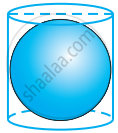
A certain number of metallic cones, each of radius 2 cm and height 3 cm are melted and recast into a solid sphere of radius 6 cm. Find the number of cones.
A hollow sphere of internal and external radii 6 cm and 8 cm respectively is melted and recast into small cones of base radius 2 cm and height 8 cm. Find the number of cones.
Find the surface area of a sphere of diameter 14 cm.
Find the surface area of a sphere of diameter 3.5 cm.
A cylinder of same height and radius is placed on the top of a hemisphere. Find the curved
surface area of the shape if the length of the shape be 7 cm.
A hemi-spherical dome of a building needs to be painted. If the circumference of the base of
the dome is 17.6 cm, find the cost of painting it, given the cost of painting is Rs. 5 per l00
`cm^2`
The surface area of a sphere is 2464 cm2, find its volume.
If the number of square centimeters on the surface of a sphere is equal to the number of cubic centimeters in its volume, what is the diameter of the sphere?
Metallic spheres of radii 6 cm, 8 cm and 10 cm respectively are melted and recasted into a single solid sphere. Taking π = 3.1, find the surface area of the solid sphere formed.
The total area of a solid metallic sphere is 1256 cm2. It is melted and recast into solid right circular cones of radius 2.5 cm and height 8 cm. Calculate :
- the radius of the solid sphere.
- the number of cones recast. [Take π = 3.14]
The diameter of a sphere is 6 cm. It is melted and drawn into a wire of diameter 0.2 cm. Find the length of the wire.
The hollow sphere, in which the circus motor cyclist performs his stunts, has a diameter of 7 m. Find the area available to the motorcyclist for riding.
Find the volume of a sphere whose surface area is 154 cm2.
If a sphere of radius 2r has the same volume as that of a cone with circular base of radius r, then find the height of the cone.
If a hollow sphere of internal and external diameters 4 cm and 8 cm respectively melted into a cone of base diameter 8 cm, then find the height of the cone.
The surface area of a sphere of radius 5 cm is five times the area of the curved surface of a cone of radius 4 cm. Find the height of the cone.
Mark the correct alternative in each of the following:
In a sphere the number of faces is
The ratio of the total surface area of a sphere and a hemisphere of same radius is
If a solid sphere of radius 10 cm is moulded into 8 spherical solid balls of equal radius, then the surface area of each ball (in sq.cm) is
If a sphere is inscribed in a cube, then the ratio of the volume of the sphere to the volume of the cube is
A sphere is placed inside a right circular cylinder so as to touch the top, base and lateral surface of the cylinder. If the radius of the sphere is r, then the volume of the cylinder is
The model of a building is constructed with the scale factor 1 : 30.
(i) If the height of the model is 80 cm, find the actual height of the building in meters.
(ii) If the actual volume of a tank at the top of the building is 27m3, find the volume of the tank on the top of the model.
If the surface area of a sphere is 2826 cm2 then find its volume. ( π= 3.14)
The radius of a sphere is 9 cm. It is melted and drawn into a wire of diameter 2 mm. Find the length of the wire in metre.
Find the length of the wire of diameter 4 m that can be drawn from a solid sphere of radius 9 m.
Find the radius of a sphere whose surface area is equal to the area of the circle of diameter 2.8 cm
A hemispherical bowl of internal radius 9 cm is full of liquid. This liquid is to be filled into conical shaped small containers each of diameter 3 cm and height 4 cm. How many containers are necessary to empty the bowl?
From a rectangular solid of metal 42 cm by 30 cm by 20 cm, a conical cavity of diameter 14 cm and depth 24 cm is drilled out. Find: the volume of remaining solid
The given figure shows the cross-section of a cone, a cylinder and a hemisphere all with the same diameter 10 cm and the other dimensions are as shown.

Calculate :
- the total surface area.
- the total volume of the solid and
- the density of the material if its total weight is 1.7 kg.
There is surface area and volume of a sphere equal, find the radius of sphere.
A sphere cut out from a side of 7 cm cubes. Find the volume of this sphere?
A vessel is in he form of an inverted cone. Its height is 11 cm., and the radius of its top which is open is 2.5 cm. It is filled with water up to the rim. When lead shots, each of which is a sphere of radius 0.25 cm., are dropped 2 into the vessel, `2/5`th of the water flows out. Find the number of lead shots dropped into the vessel.
A manufacturing company prepares spherical ball bearings, each of radius 7 mm and mass 4 gm. These ball bearings are packed into boxes. Each box can have a maximum of 2156 cm3 of ball bearings. Find the:
- maximum number of ball bearings that each box can have.
- mass of each box of ball bearings in kg.
(Use π = `22/7`)
