Advertisements
Advertisements
प्रश्न
Find the odd one out and give its explanation.
विकल्प
Carbon
Calcium
Oxygen
Neon
Advertisements
उत्तर
Calcium
Explanation:
Carbon, oxygen, and neon are all classified as non-metals and are found in the p-block of the periodic table. Calcium, on the other hand, is an alkaline earth metal (Group 2) and is categorised as a metal, making it distinct from the others in terms of physical and chemical properties.
APPEARS IN
संबंधित प्रश्न
Name two elements you would expect to show chemical reactions similar to magnesium. What is the basis for your choice?
How does the electronic configuration of an atom relate to its position in the Modern Periodic Table?
The atomic numbers of four elements P, Q, R and S are 6, 8, 14 and 16 respectively. Out of these, the element known as metalloid is:
(a) P
(b) Q
(c) R
(d) S
How does the chemical reactivity of alkali metals vary on going in group 1 of the periodic table?
Explain why all the elements of a period have different chemical properties.
Give the group number of following elements present in periodic table
Correct the statement.
Copper and zinc are representative elements.
Name two elements in each case:
Actinides
Name the type of elements which have two outermost shell incomplete.
Name the type of elements which have two electrons in the outermost orbit.
State its position in the periodic table?
Write the number of protons, neutrons and electronic configuration of \[\ce{_19^39K, _15^31P}\]. Also state their position in periodic table.
What is meant in the periodic table by a period?
The horizontal rows in a periodic table are called _____.
In the Modern Periodic Table – atoms of all elements are arranged according to their increasing order of – atomic numbers. An atom of nitrogen has seven protons and seven electrons. State what would be its atomic number.
Give the symbol and valency of the following element and radical.
Potassium
Give the symbol and valency of the following element and radical.
Hydrogen
Give the symbol and valency of the following element and radical.
Nitrogen [Nitride]
Give the symbol and valency of the following element and radical.
Bisulphite
Give the chemical formula of calcium phosphate
What are the elements.
Compare Modern Periodic Law with Mendeleev's Periodic Law.
Find the correlation:
Group 13 to 18 : p block : : ______ : d block
Find the odd one out and give its explanation.
Write an explanation.
Period
Complete the following flow chart.
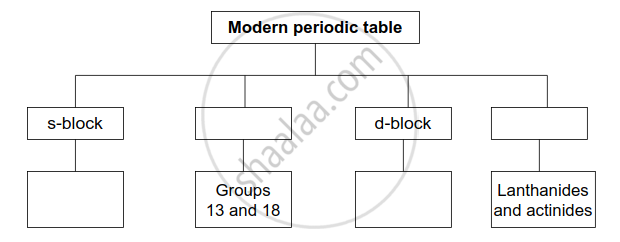
Explain structure of modern periodic table in short.
______ is the longest period in the periodical table.
In the modern periodic table, elements are arranged according to their ______
Where would you locate the element with electronic configuration 2,8 in the Modern Periodic Table?
If an element X is placed in group 14, what will be the formula and the nature of bonding of its chloride?
Arrange the following elements in the increasing order of their metallic character
| Mg, | Ca, | K, | Ge, | Ga |
An element X which is a yellow solid at room temperature shows catenation and allotropy. X forms two oxides which are also formed during the thermal decomposition of ferrous sulphate crystals and are the major air pollutants.
- Identify the element X
- Write the electronic configuration of X
- Write the balanced chemical equation for the thermal decomposition of ferrous sulphate crystals?
- What would be the nature (acidic/ basic) of oxides formed?
- Locate the position of the element in the Modern Periodic Table.
Group 16 elements are collectively called as ______.
A part of modern periodic table is given below. On its basis, answer the following questions:
| Group No. → | 1 | 2 | 13 | 14 | 15 | 16 | 17 | 18 |
| Period ↓ | ||||||||
| 2 | A | B | ||||||
| 3 | E | D | F | C |
Write the molecular formula of the compound formed by the combination:
E and B
Give the criteria on the basis of which elements are placed (i) in a group and (ii) in a period in the modern periodic table. The atomic number of an element is 16. According to the criteria, in which group and period it should be placed?
Define groups of modern periodic table.
