Advertisements
Advertisements
प्रश्न
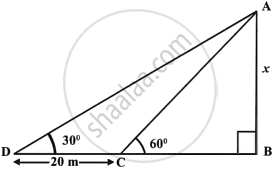
Find the height of a tree when it is found that on walking away from it 20 m, in a horizontal line through its base, the elevation of its top changes from 60° to 30°.
Advertisements
उत्तर
Let AB be the tree and its height be x
DC = 20 m.
Now in right ΔADB,
`tan theta = (AB)/(DB)`
`\implies tan 30^circ = x/(DB)`
`\implies 1/sqrt(3) = x/(DB)`
`\implies DB = sqrt(3)x`. ...(i)
In ΔACB, we have
`tan 60^circ = x/(CB)`
`\implies sqrt(3)/1 = x/(CB)`
∴ `CB = x/sqrt(3) = (sqrt(3)x)/3` ...(ii)
But DB – CB = DC
`\implies sqrt(3)x - (sqrt(3)x)/3 = 20`
`\implies (3sqrt(3)x - sqrt(3)x)/3 = 20`
`\implies (2sqrt(3)x)/3 = 20`
`\implies x = (20 xx 3)/(2sqrt(3))`
= `(10 xx 3 xx sqrt(3))/(sqrt(3) xx sqrt(3))`
= `(30sqrt(3))/3`
∴ `x = 10sqrt(3)`
= 10 × (1.732)
= 17.32 m.
∴ Required height of the tree = 17.32 m
