Advertisements
Advertisements
प्रश्न
Find the area of the region lying between the parabolas 4y2 = 9x and 3x2 = 16y
Advertisements
उत्तर
Given equations of the parabolas are
4y2 = 9x .......(i)
and 3x2 = 16y
∴ y = `(3x^2)/16` ......(ii)
From (i), we get
y2 = `9/4x`
∴ y = `3/2 sqrt(x)` ....(iii) ......[∵ In first quadrant, y > 0]
Find the points of intersection of 4y2 = 9x and 3x2 = 16y.
Substituting (ii) in (i), we get
`4((3x^2)/16)^2` = 9x
∴ x4 = 64x
∴ x4 – 64x = 0
∴ x(x3 – 64) = 0
∴ x = 0 or x3 = 64 = 43
∴ x = 0 or x = 4
When x = 0, y = 0 and when x = 4, y = 3
∴ The points of intersection are O(0, 0) and B(4, 3).
Draw BD ⊥ OX.
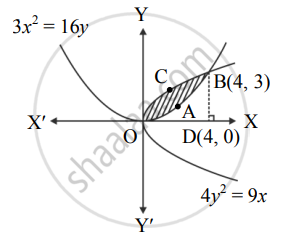
Required area = area of the region OABCO
= area of the region ODBCO – area of the region ODBAO
= area under the parabola 4y2 = 9x – area under the parabola 3x2 = 16y
= `int_0^4 3/2 sqrt(x) "d"x - int_0^4 (3x^2)/16 "d"x`
= `3/2 int_0^4 x^(1/2) "d"x - 3/16 int_0^4 x^2 "d"x`
= `3/2[(x^(3/2))/(3/2)]_0^4 - 3/16[x^3/3]_0^4`
= `[(4)^(3/2) - 0] - 1/16[(4)^3 - 0]`
= `8 - 1/16 (64)`
= 8 – 4
= 4 sq.units
APPEARS IN
संबंधित प्रश्न
Using integration, find the area of the region bounded by the triangle whose vertices are (−1, 2), (1, 5) and (3, 4).
Find the area bounded by curves (x – 1)2 + y2 = 1 and x2 + y 2 = 1
Find the area of the region bounded by the curves y = x2 + 2, y = x, x = 0 and x = 3
Using integration finds the area of the region bounded by the triangle whose vertices are (–1, 0), (1, 3) and (3, 2).
Using integration find the area of the triangular region whose sides have the equations y = 2x +1, y = 3x + 1 and x = 4.
Smaller area enclosed by the circle x2 + y2 = 4 and the line x + y = 2 is
A. 2 (π – 2)
B. π – 2
C. 2π – 1
D. 2 (π + 2)
Area lying between the curve y2 = 4x and y = 2x is
A. 2/3
B. 1/3
C. 1/4
D. 3/4
Using the method of integration find the area bounded by the curve |x| + |y| = 1 .
[Hint: The required region is bounded by lines x + y = 1, x– y = 1, – x + y = 1 and
– x – y = 1].
Find the area bounded by curves {(x, y) : y ≥ x2 and y = |x|}.
Choose the correct answer The area of the circle x2 + y2 = 16 exterior to the parabola y2 = 6x is
A. `4/3 (4pi - sqrt3)`
B. `4/3 (4pi + sqrt3)`
C. `4/3 (8pi - sqrt3)`
D.`4/3 (4pi + sqrt3)`
The area bounded by the y-axis, y = cos x and y = sin x when 0 <= x <= `pi/2`
(A) 2 ( 2 −1)
(B) `sqrt2 -1`
(C) `sqrt2 + 1`
D. `sqrt2`
Using integration, find the area of region bounded by the triangle whose vertices are (–2, 1), (0, 4) and (2, 3).
Show that the rectangle of the maximum perimeter which can be inscribed in the circle of radius 10 cm is a square of side `10sqrt2` cm.
The area between x-axis and curve y = cos x when 0 ≤ x ≤ 2 π is ___________ .
Area lying between the curves y2 = 4x and y = 2x is
The area of the region included between the parabolas y2 = 16x and x2 = 16y, is given by ______ sq.units
The area enclosed between the two parabolas y2 = 20x and y = 2x is ______ sq.units
Find the area enclosed between y = cos x and X-axis between the lines x = `pi/2` and x ≤ `(3pi)/2`
Find the area of the ellipse `x^2/1 + y^2/4` = 1, in first quadrant
Find the area enclosed by the curve x = 3 cost, y = 2 sint.
Find the area of the region bounded by the curves x = at2 and y = 2at between the ordinate corresponding to t = 1 and t = 2.
Find the area of a minor segment of the circle x2 + y2 = a2 cut off by the line x = `"a"/2`
Calcualte the area under the curve y = `2sqrt(x)` included between the lines x = 0 and x = 1
Draw a rough sketch of the curve y = `sqrt(x - 1)` in the interval [1, 5]. Find the area under the curve and between the lines x = 1 and x = 5.
Determine the area under the curve y = `sqrt("a"^2 - x^2)` included between the lines x = 0 and x = a.
Area lying between the curves `y^2 = 4x` and `y = 2x`
The value of a for which the area between the curves y2 = 4ax and x2 = 4ay is 1 sq.unit, is ______.
Let the area enclosed by the x-axis, and the tangent and normal drawn to the curve 4x3 – 3xy2 + 6x2 – 5xy – 8y2 + 9x + 14 = 0 at the point (–2, 3) be A. Then 8A is equal to ______.
Using Integration, find the area of triangle whose vertices are (– 1, 1), (0, 5) and (3, 2).
Find the area enclosed between 3y = x2, X-axis and x = 2 to x = 3.
