Advertisements
Advertisements
प्रश्न
Find the perpendicular distance of the point (3, −1, 11) from the line \[\frac{x}{2} = \frac{y - 2}{- 3} = \frac{z - 3}{4} .\]
Advertisements
उत्तर
Given equation of line AB is
`x/2=("y"-2)/3=("z"-3)/4=lambda`[say]
or `x/2=lambda,("y"-2)/3=lambda`
and `("z"-3)/4=lambda`
or x = 2λ, y = 3λ + 2
and z = 4λ + 3
∴ Any point P on the given line
= (2λ, 3λ + 2, 4λ + 3)
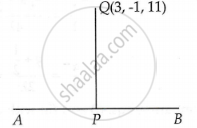
Let P be the foot of Perpendicular drawn from point
Q(3, -1, 11) on line AB. Now, DR's of line
QP = (2λ - 3, 3λ + 2 + 1, 4λ + 3 - 11)
= (2λ - 3, 3λ + 3, 4λ - 8)
Here, a1 = 2λ -3, b1 = 3λ + 3, c1 = 4λ - 8,
and a2 = 2, b2 = 3, c2 = 4
Since, QP ⊥ AB
∴ We have, a1a2 + b1b2 + c1c2 = 0 ...(i)
or 2(2λ - 3) + 3 (3λ + 3) + 4 (4λ - 8) = 0
or 4λ - 6 + 9λ + 9 + 16λ - 32 = 0
or 29λ - 29 = 0 or 29λ = 29 or λ = 1
∴ Foot of Perpendicular
P = (2, 3 + 2, 4 + 3)
= (2, 5, 7)
Now, equation of Perpendicular QP, Where Q (3, -1, 11) and P (2, 5, 7) is
`(x-3)/(2-3)=("y"+1)/(5+1)=("z"-11)/(7-11)`
`[("using two points form of equation of line"), ("i"."e". (x-x_1)/(x_2-x_1)=("y"-"y"_1)/("y"_2-"y"_1)=("z"-"z"_1)/("z"_2-"z"_1))]`
or `(x-3)/-1=("y"+1)/6=("z"-11)/-4`
Now, length of Perpendicular QP = distance between points Q(3, -1, 11) and P (2, 5, 7)
= `sqrt((2-3)^2+(5+1)^2+(7-11)^2)`
`[(∵ "distance"), (=sqrt((x_2-x_1)^2+("y"_2-"y"_1)^2+("z"_2-"z"_1)^2))]`
= `sqrt(1+36+16)`
= `sqrt53`
Hence, length of Perpendicular is `sqrt53`.
APPEARS IN
संबंधित प्रश्न
Find the Cartesian equation of the line which passes through the point (−2, 4, −5) and is parallel to the line `(x+3)/3=(4-y)/5=(z+8)/6`
If the Cartesian equations of a line are ` (3-x)/5=(y+4)/7=(2z-6)/4` , write the vector equation for the line.
Find the equation of the line which passes through the point (1, 2, 3) and is parallel to the vector `3hati+2hatj-2hatk`.
Find the vector and the Cartesian equations of the lines that pass through the origin and (5, −2, 3).
Find the vector equation of the line passing through the points (−1, 0, 2) and (3, 4, 6).
The cartesian equations of a line are \[\frac{x - 5}{3} = \frac{y + 4}{7} = \frac{z - 6}{2} .\] Find a vector equation for the line.
Show that the line through the points (4, 7, 8) and (2, 3, 4) is parallel to the line through the points (−1, −2, 1) and, (1, 2, 5).
Find the cartesian equation of the line which passes through the point (−2, 4, −5) and parallel to the line given by \[\frac{x + 3}{3} = \frac{y - 4}{5} = \frac{z + 8}{6} .\]
Find the equation of a line parallel to x-axis and passing through the origin.
Find the angle between the pairs of lines with direction ratios proportional to 2, 2, 1 and 4, 1, 8 .
If the lines \[\frac{x - 1}{- 3} = \frac{y - 2}{2 \lambda} = \frac{z - 3}{2} \text{ and } \frac{x - 1}{3\lambda} = \frac{y - 1}{1} = \frac{z - 6}{- 5}\] are perpendicular, find the value of λ.
Find the value of λ so that the following lines are perpendicular to each other. \[\frac{x - 5}{5\lambda + 2} = \frac{2 - y}{5} = \frac{1 - z}{- 1}, \frac{x}{1} = \frac{2y + 1}{4\lambda} = \frac{1 - z}{- 3}\]
Show that the lines \[\frac{x}{1} = \frac{y - 2}{2} = \frac{z + 3}{3} \text{ and } \frac{x - 2}{2} = \frac{y - 6}{3} = \frac{z - 3}{4}\] intersect and find their point of intersection.
Prove that the lines through A (0, −1, −1) and B (4, 5, 1) intersects the line through C (3, 9, 4) and D (−4, 4, 4). Also, find their point of intersection.
Find the foot of the perpendicular drawn from the point A (1, 0, 3) to the joint of the points B (4, 7, 1) and C (3, 5, 3).
A (1, 0, 4), B (0, −11, 3), C (2, −3, 1) are three points and D is the foot of perpendicular from A on BC. Find the coordinates of D.
Find the length of the perpendicular drawn from the point (5, 4, −1) to the line \[\overrightarrow{r} = \hat{i} + \lambda\left( 2 \hat{i} + 9 \hat{j} + 5 \hat{k} \right) .\]
Find the equation of the perpendicular drawn from the point P (−1, 3, 2) to the line \[\overrightarrow{r} = \left( 2 \hat{j} + 3 \hat{k} \right) + \lambda\left( 2 \hat{i} + \hat{j} + 3 \hat{k} \right) .\] Also, find the coordinates of the foot of the perpendicular from P.
Find the equation of line passing through the points A (0, 6, −9) and B (−3, −6, 3). If D is the foot of perpendicular drawn from a point C (7, 4, −1) on the line AB, then find the coordinates of the point D and the equation of line CD.
Find the shortest distance between the following pairs of lines whose vector equations are: \[\overrightarrow{r} = \left( 3 \hat{i} + 5 \hat{j} + 7 \hat{k} \right) + \lambda\left( \hat{i} - 2 \hat{j} + 7 \hat{k} \right) \text{ and } \overrightarrow{r} = - \hat{i} - \hat{j} - \hat{k} + \mu\left( 7 \hat{i} - 6 \hat{j} + \hat{k} \right)\]
Find the shortest distance between the following pairs of parallel lines whose equations are: \[\overrightarrow{r} = \left( \hat{i} + 2 \hat{j} + 3 \hat{k} \right) + \lambda\left( \hat{i} - \hat{j} + \hat{k} \right) \text{ and } \overrightarrow{r} = \left( 2 \hat{i} - \hat{j} - \hat{k} \right) + \mu\left( - \hat{i} + \hat{j} - \hat{k} \right)\]
Write the angle between the lines \[\frac{x - 5}{7} = \frac{y + 2}{- 5} = \frac{z - 2}{1} \text{ and } \frac{x - 1}{1} = \frac{y}{2} = \frac{z - 1}{3} .\]
Write the angle between the lines 2x = 3y = −z and 6x = −y = −4z.
If the equations of a line AB are
\[\frac{3 - x}{1} = \frac{y + 2}{- 2} = \frac{z - 5}{4},\] write the direction ratios of a line parallel to AB.
Find the Cartesian equations of the line which passes through the point (−2, 4 , −5) and is parallel to the line \[\frac{x + 3}{3} = \frac{4 - y}{5} = \frac{z + 8}{6} .\]
Find the angle between the lines
\[\vec{r} = \left( 2 \hat{i} - 5 \hat{j} + \hat{k} \right) + \lambda\left( 3 \hat{i} + 2 \hat{j} + 6 \hat{k} \right)\] and \[\vec{r} = 7 \hat{i} - 6 \hat{k} + \mu\left( \hat{i} + 2 \hat{j} + 2 \hat{k} \right)\]
The lines `x/1 = y/2 = z/3 and (x - 1)/-2 = (y - 2)/-4 = (z - 3)/-6` are
The direction ratios of the line perpendicular to the lines \[\frac{x - 7}{2} = \frac{y + 17}{- 3} = \frac{z - 6}{1} \text{ and }, \frac{x + 5}{1} = \frac{y + 3}{2} = \frac{z - 4}{- 2}\] are proportional to
The straight line \[\frac{x - 3}{3} = \frac{y - 2}{1} = \frac{z - 1}{0}\] is
The separate equations of the lines represented by `3x^2 - 2sqrt(3)xy - 3y^2` = 0 are ______
If 2x + y = 0 is one of the line represented by 3x2 + kxy + 2y2 = 0 then k = ______
The distance of the point (4, 3, 8) from the Y-axis is ______.
Find the vector equation of the lines passing through the point having position vector `(-hati - hatj + 2hatk)` and parallel to the line `vecr = (hati + 2hatj + 3hatk) + λ(3hati + 2hatj + hatk)`.
For the point \[(5,2,-4)\], what is its position vector \[\vec{a}\]?
