Advertisements
Advertisements
प्रश्न
Find the area of the triangle ABC with A(1, −4) and mid-points of sides through A being (2, −1) and (0, −1).
Advertisements
उत्तर
Let the coordinates of points B and C of the ∆ABC be (a1, b1) and (a2, b2), respectively.
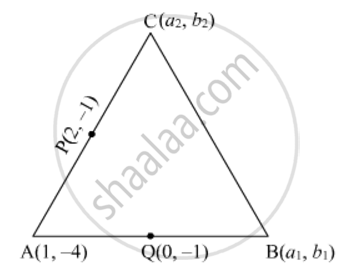
Q is the midpoint of AB.
Using midpoint formula, we have
`(0,-1)=((a_1+1)/2,(b_1-4)/2)`
`=>(a_1+1)/2=0 `
⇒ a1=−1 and b1=2
Therefore, the coordinates of B are (−1, 2).
P is the midpoint of AC.
Now,
`(2,-1)=((a_2+1)/2,(b_2-4)/2)`
`=>(a_2+1)/2=2`
⇒ a2=3 and b2=2
Therefore, the coordinates of C are (3, 2)
Thus, the vertices of ∆ABC are A(1,−4), B(−1, 2) and C(3, 2).
Now,
Area of the triangle having vertices (x1, y1), (x2, y2) and (x3, y3) = `1/2`[x1(y2−y3)+x2(y3−y1)+x3(y1−y2)]
∴ Area of ∆ABC = `1/2`[x1(y2−y3)+x2(y3−y1)+x3(y1−y2)]
= `1/2`×[1(2−2)+(−1)(2+4)+3(−4−2)]
= `1/2`(−6−18)
= `1/2` (−24)
=−12
Since area is a measure that cannot be negative, we will take the numerical value of −12, that is, 12. Thus, the area of ∆ABC is 12 square units
