हिंदी

Find the Area Bounded by the Curve Y = 4 − X2 and the Lines Y = 0, Y = 3. - Mathematics

Advertisements
Advertisements

प्रश्न

Find the area bounded by the curve y = 4 − x2 and the lines y = 0, y = 3.

योग
Advertisements

उत्तर

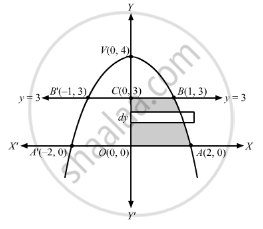
\[y = 4 - x^2\text{ is a parabola, with vertex (0, 4), opening downwars and having axis of symmetry as - ve }y -\text{ axis }\]
\[y = 0\text{ is the }x - \text{ axis, cutting the parabola at }A(2, 0)\text{ and A'}( - 2, 0)\]
\[y = 3\text{ is a line parallel to }x - \text{ axis, cutting the parabola at B }(1, 3 )\text{ and B'}( - 1, 3) \text{ and }y -\text{ axis at }C(0, 3) \]
\[\text{ Required area is the shaded area ABB'A }= 2 \left(\text{ area ABCO }\right)\]
\[\text{ Consider a horizontal strip of length }= \left| x_2 - x_1 \right|\text{ and width = dy in the shaded region }\]
\[\text{ Area of approximating rectangle }= \left| x_2 - x_1 \right| dy\]
\[\text{ The approximating rectangle moves from }y = 0\text{ to }y = 3 \]
\[ \therefore\text{ Area of shaded region }= 2 \int_3^0 \left| x_2 - x_1 \right| dy \]
\[ \Rightarrow A = 2 \int_0^3 \left( x_2 - x_1 \right) dy ...............\left[ As, \left| x_2 - x_1 \right| = x_2 - x_{1 ,} x_2 > x_1 \right] \]
\[ \Rightarrow A = 2 \int_0^3 \left( \sqrt{4 - y} - 0 \right) dy\]
\[ \Rightarrow A = - 2 \left[ \frac{\left( 4 - y \right)^\frac{3}{2}}{\frac{3}{2}} \right]_0^3 \]
\[ \Rightarrow A = 2 \times \frac{2}{3}\left[ 4^\frac{3}{2} - 1^\frac{3}{2} \right]\]
\[ \Rightarrow A = \frac{4}{3} \times 7 \]
\[ \Rightarrow A = \frac{28}{3}\text{ sq . units }\]
\[ \therefore \text{ Area bounded by the two parabolas }= \frac{28}{3}\text{ sq . units }\]

shaalaa.com
  क्या इस प्रश्न या उत्तर में कोई त्रुटि है?
अध्याय 21: Areas of Bounded Regions - Exercise 21.3 [पृष्ठ ५१]

APPEARS IN

आरडी शर्मा Mathematics [English] Class 12
अध्याय 21 Areas of Bounded Regions
Exercise 21.3 | Q 4 | पृष्ठ ५१

वीडियो ट्यूटोरियलVIEW ALL [1]

संबंधित प्रश्न

Using integration, find the area bounded by the curve x2 = 4y and the line x = 4y − 2.


Find the equation of a curve passing through the point (0, 2), given that the sum of the coordinates of any point on the curve exceeds the slope of the tangent to the curve at that point by 5.


Draw a rough sketch of the curve and find the area of the region bounded by curve y2 = 8x and the line x =2.


Sketch the graph of y = |x + 4|. Using integration, find the area of the region bounded by the curve y = |x + 4| and x = –6 and x = 0.


Using integration, find the area of the region bounded between the line x = 2 and the parabola y2 = 8x.


Using integration, find the area of the region bounded by the line y − 1 = x, the x − axis and the ordinates x= −2 and x = 3.


Find the area of the region bounded by the parabola y2 = 4ax and the line x = a. 


Find the area lying above the x-axis and under the parabola y = 4x − x2.


Determine the area under the curve y = `sqrt(a^2-x^2)` included between the lines x = 0 and x = a.


Sketch the graph y = | x − 5 |. Evaluate \[\int\limits_0^1 \left| x - 5 \right| dx\]. What does this value of the integral represent on the graph.


Find the area of the region common to the parabolas 4y2 = 9x and 3x2 = 16y.


Find the area of the region between the circles x2 + y2 = 4 and (x − 2)2 + y2 = 4.


Find the area of the region included between the parabola y2 = x and the line x + y = 2.


Find the area of the region bounded by \[y = \sqrt{x}, x = 2y + 3\]  in the first quadrant and x-axis.


Find the area enclosed by the curve \[y = - x^2\] and the straight line x + y + 2 = 0. 


Find the area bounded by the parabola y = 2 − x2 and the straight line y + x = 0.


Find the area bounded by the curves x = y2 and x = 3 − 2y2.


Using integration find the area of the region:
\[\left\{ \left( x, y \right) : \left| x - 1 \right| \leq y \leq \sqrt{5 - x^2} \right\}\]


Find the area bounded by the lines y = 4x + 5, y = 5 − x and 4y = x + 5.


The area bounded by y = 2 − x2 and x + y = 0 is _________ .


The area bounded by the parabola x = 4 − y2 and y-axis, in square units, is ____________ .


The area of the region \[\left\{ \left( x, y \right) : x^2 + y^2 \leq 1 \leq x + y \right\}\] is __________ .


The area bounded by the curve y = f (x), x-axis, and the ordinates x = 1 and x = b is (b −1) sin (3b + 4). Then, f (x) is __________ .


The area bounded by the parabola y2 = 8x, the x-axis and the latusrectum is ___________ .


Draw a rough sketch of the curve y2 = 4x and find the area of region enclosed by the curve and the line y = x.


Sketch the graphs of the curves y2 = x and y2 = 4 – 3x and find the area enclosed between them. 


Find the area of the region bounded by the curve y2 = 4x, x2 = 4y.


The area of the region bounded by the curve y = x + 1 and the lines x = 2 and x = 3 is ______.


If a and c are positive real numbers and the ellipse `x^2/(4c^2) + y^2/c^2` = 1 has four distinct points in common with the circle `x^2 + y^2 = 9a^2`, then


Find the area of the region bounded by `x^2 = 4y, y = 2, y = 4`, and the `y`-axis in the first quadrant.


For real number a, b (a > b > 0),

let Area `{(x, y): x^2 + y^2 ≤ a^2 and x^2/a^2 + y^2/b^2 ≥ 1}` = 30π

Area `{(x, y): x^2 + y^2 ≥ b^2 and x^2/a^2 + y^2/b^2 ≤ 1}` = 18π.

Then the value of (a – b)2 is equal to ______.


Let the curve y = y(x) be the solution of the differential equation, `("dy")/("d"x) = 2(x + 1)`. If the numerical value of area bounded by the curve y = y(x) and x-axis is `(4sqrt(8))/3`, then the value of y(1) is equal to ______.


Area (in sq.units) of the region outside `|x|/2 + |y|/3` = 1 and inside the ellipse `x^2/4 + y^2/9` = 1 is ______.


Let a and b respectively be the points of local maximum and local minimum of the function f(x) = 2x3 – 3x2 – 12x. If A is the total area of the region bounded by y = f(x), the x-axis and the lines x = a and x = b, then 4A is equal to ______.


Let g(x) = cosx2, f(x) = `sqrt(x)`, and α, β (α < β) be the roots of the quadratic equation 18x2 – 9πx + π2 = 0. Then the area (in sq. units) bounded by the curve y = (gof)(x) and the lines x = α, x = β and y = 0, is ______.


Let P(x) be a real polynomial of degree 3 which vanishes at x = –3. Let P(x) have local minima at x = 1, local maxima at x = –1 and `int_-1^1 P(x)dx` = 18, then the sum of all the coefficients of the polynomial P(x) is equal to ______.


Find the area of the smaller region bounded by the curves `x^2/25 + y^2/16` = 1 and `x/5 + y/4` = 1, using integration.


Share
Notifications

Englishहिंदीमराठी


      Forgot password?
Use app×