Advertisements
Advertisements
प्रश्न
Fill in the blank.
______ is referred to as a festival of sacrifice.
Advertisements
उत्तर
Joy of giving is referred to as a festival of sacrifice.
APPEARS IN
संबंधित प्रश्न
Maggu’s achievements are particularly noteworthy because – as is well known – academic institutions in India are less than sold on the idea of inclusive education. In fact, when Maggu lost her sight in class IV, her school (which she declines to name) expelled her while suggesting she attend a “blind school”. Though shocked, Maggu rejected the advice. “Attending a special school would have tarred me with a handicap forever, which was not how I saw my future. Therefore I did the rounds of other public schools with my father, a small – time merchant, explaining that my case was different Since I had vision till the age of ten,” she recalls.
Impressed by her persistence and ambition, Delhi’s Bluebells School not only admitted her but pulled out all the stops to support her in academics sporting events and also notched up a respectable 73 percent average in the class XII exam with the help of Braille, interactive textbooks and extra coaching.
The respectable average in her CBSE exam paved the way for admission into LSR where again she proved her mettle by winning medals in a slew of inter – collage events (100 200 and 400 metre sprints) high jump, long jump, javelin and discuss throw: resulting in her being declared ‘Athlete of the year’ 2003’ at a sports meet for 100 physically challenged athletes. And the cherry on the cake was the selection to the IBSA Games last year. “It was a tough regimen,” recalls Maggu. “I had to attend sports camps manage my studies and officiates as sports president. But I managed.”
Questions:
(1) What qualities of Maggu are highlighted in this passage?
(2) Why did Maggu refuse to attend a ‘blind school’?
(3) Quote the lines that show that Jyoti Maggu was good in academics as well as in sports.
(4) Use any two phrases in sentences of your own :
(a) To win laurels
(b) To pave the way
(c) To prove one’s mettle
(d) A tough regimen
(5)
(a) I did the rounds of other public schools with my father [Change the voice]
(b) though shocked Maggu rejected the advice [Rewrite as a simple sentence]
(6) Should the physically challenged be sent to special schools? Express your views.
' Kummi', ' ghumar' and 'dandia' are some dance forms mentioned in the text. Make an inventory of folk dance forms in the different regions of the country.
Apart from the children, no other human beings are mentioned in the poem. However, many natural elements are shown to act like persons. Name them and also write what they do.
How are fabrics used in our daily life? List all the things that are made up of fabrics in your home. (At least 25)
Match the columns :
| A | B |
| (1) Theseus | (1) Robin Goodfellow |
| (2) Titania | (2) Queen of the Amazons |
| (3) Puck | (3) Duke of Athens |
| (4) Hippolyta | (4) Faeries |
| (5) Cobweb, Moth | (5) Queen of the Faeries |
Note that most of the time well-known works are parodied, because people can enjoy the parody better when they know the original. Try to find more examples of parodies in English or other languages.
Write slogans for the cleanliness drive in your area.
Who is Raj?
What was their new hobby?
Read the following passage and do the activities.
A1. State whether the following sentences are True or false. [2]
- The king’s temperament also changed.
- The king was happy with prediction of the astrologer.
- The courtiers sought an audience with Tenali Raman.
- Courtiers advised the king to regulate his diet.
A2. Complete the web. [2]
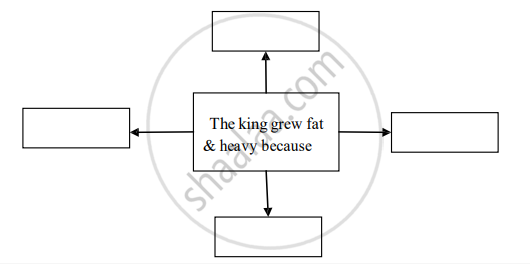
|
King Krishnadeva Raya would perform heavy exercises every morning. He regularly applied oil on his body and thereafter worked out till all the oil came out with the sweat. This was followed by a long ride on his horse. Once the king started leading a sedentary lifestyle, and he stopped exercising. He no longer went horse-riding either. The king overate and as a result grew fat and heavy. The king‟s temperament also underwent a sea change. Noticing this, the royal physicians cautioned the king against the ill effects of overeating and explained to him the risks posed by obesity. They advised the king to regulate his diet, exercise, and take care of his health. The repeated advice he got from the physicians to eat less made him so angry that one day he announced a reward for anyone who could find him an easy cure. But there was one condition: those who failed would have their heads off. None dared to advise the king in this regard. The situation became precarious and as usual Tenali Raman was approached by the courtiers for a remedy. Tenali heard the problem and assured the courtiers of a viable solution. The next day, an astrologer predicted that the king had only a month left to live. When the king came to know of this, he was furious. The astrologer was ordered by the king to be imprisoned for a month so that his prediction could be put to test and so the hapless forecaster was sent to prison. |
A3. Find out describing words from the passage for the words given below. [2]
- exercise - ...........
- lifestyle - ...........
- ride - ...........
- physician - ...........
A4. Do as directed. [2]
- King Krishnadeva Raya would perform heavy exercises every morning.
(Use ‘used to’) - They advised the king to regulate his diet. (Pick out the infinitive)
A5. What are the benefits of daily exercise? [2]
