Advertisements
Advertisements
प्रश्न
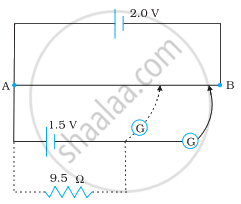
Figure shows a 2.0 V potentiometer used for the determination of internal resistance of a 1.5 V cell. The balance point of the cell in open circuit is 76.3 cm. When a resistor of 9.5 Ω is used in the external circuit of the cell, the balance point shifts to 64.8 cm length of the potentiometer wire. Determine the internal resistance of the cell.
Advertisements
उत्तर
Internal resistance of the cell = r
Balance point of the cell in open circuit, l1 = 76.3 cm
An external resistance (R) is connected to the circuit with R = 9.5 Ω
New balance point of the circuit, l2 = 64.8 cm
Current flowing through the circuit = I
The relation connecting resistance and emf is,
r = `(("l"_1 - "l"_2)/"l"_2) "R"`
= `(76.3 - 64.8)/64.8 xx 9.5`
= 1.68 Ω
Therefore, the internal resistance of the cell is 1.68 Ω.
संबंधित प्रश्न
SI unit of potential gradient is _______.
(a) V cm
(b) `V/"cm"`
(c) Vm
(d) `V/m`
In the given circuit, with steady current, calculate the potential drop across the capacitor and the charge stored in it.

(i) State the principle on which a potentiometer works. How can a given potentiometer be made more sensitive?

State the underlying principle of a potentiometer ?
State the principle of a potentiometer. Define potential gradient. Obtain an expression for potential gradient in terms of resistivity of the potentiometer wire.
Two students ‘X’ and ‘Y’ perform an experiment on potentiometer separately using the circuit given below:

Keeping other parameters unchanged, how will the position of the null point be affected if
(i) ‘X’ increases the value of resistance R in the set-up by keeping the key K1 closed and the Key K2 opens?
(ii) ‘Y’ decreases the value of resistance S in the set-up, while the key K2 remains open and they K1 closed?
Justify.
When a resistor of 5Ω is connected across the cell, its terminal potential difference is balanced by 150 cm of potentiometer wire and when a resistance of 10 Ω is connected across the cell, the terminal potential difference is balanced by 175 cm same potentiometer wire. Find the balancing length when the cell is in open circuit and the internal resistance of the cell.
Describe how a potentiometer is used to compare the EMFs of two cells by connecting the cells individually.
A battery of emf 4 volt and internal resistance 1 Ω is connected in parallel with another battery of emf 1 V and internal resistance 1 Ω (with their like poles connected together). The combination is used to send current through an external resistance of 2 Ω. Calculate the current through the external resistance.
The instrument which can measure terminal potential difference as well as electromotive force (emf) is ______
The emf of a standard cell is 1.5V and is balanced by a length of 300 cm of a potentiometer with a 10 m long wire. Find the percentage error in a voltmeter that balances at 350 cm when its reading is 1.8 V.
Which of the following instruments is not a direct reading instrument?
A potentiometer wire has length L For given cell of emf E, the balancing length is `"L"/3` from 3 the positive end of the wire. If the length of the potentiometer wire is increased by 50%, then for the same cell, the balance point is obtained at length.
To determine the internal resistance of a cell by using potentiometer, the null point is at 1 m when cell is shunted by 3 Ω resistance and at a length 1.5 m when cell is shunted by 6 Ω resistance. The internal resistance of the cell is ______.
The length of a wire of a potentiometer is 100 cm, and the e.m.f of its standard cell is E volt. It is employed to measure the e.m.f of a battery whose internal resistance is 0.5 `Omega` If the balance point is obtained at `l`= 30 cm from the positive end, the e.m.f of the battery is ____________.
where 'i' is the current in the potentiometer
In the potentiometer experiment, the balancing length with cell E1 of unknown e.m.f. is ℓ1 cm. By shunting the cell E1 with resistance 'R' which is equal to internal resistance (r) of the cell E1, the balancing length ℓ2 is ______
AB is a wire of potentiometer with the increase in value of resistance R, the shift in the balance point J will be:

Three resistance each of 4Ω are connected to from a triangle. The resistance b / w two terminal is
The value of current I in the network shown in fig.

In an experiment with a potentiometer, VB = 10V. R is adjusted to be 50Ω (Figure). A student wanting to measure voltage E1 of a battery (approx. 8V) finds no null point possible. He then diminishes R to 10Ω and is able to locate the null point on the last (4th) segment of the potentiometer. Find the resistance of the potentiometer wire and potential drop per unit length across the wire in the second case.

